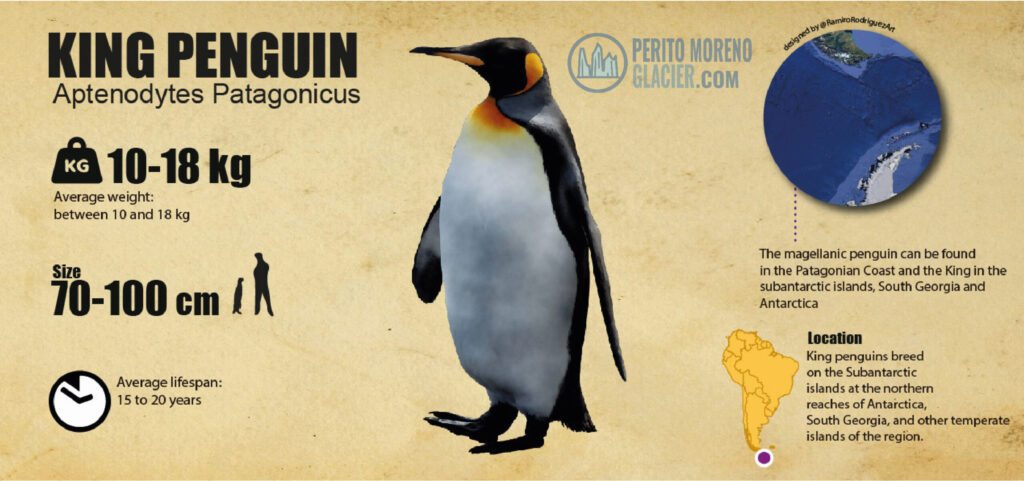
The King Penguin is the second largest among the 18 penguin species worldwide, weighing between 12 and 16 kg and measuring around 90 cm. Mostly pelagic, it comes ashore only during the breeding season. Sexual maturity is reached between 3 and 6 years, and its reproductive cycle lasts about 14–15 months, from courtship to fledging. The species usually breeds every two to three years, laying a single egg that both parents incubate atop their legs.
This migratory bird travels vast distances in search of food, moving between breeding grounds on sub-Antarctic islands and the Antarctic circumpolar waters. In the southern region of South America, important breeding sites include South Georgia and the Falkland/Malvinas Islands. Since 2010, a small colony has been established at Bahía Inútil on the Chilean side of Tierra del Fuego. Although historically rare, sightings from Cabo de Hornos and Tierra del Fuego have become increasingly common. Outside the breeding season, the species disperses across the southern circumpolar zone and the Argentine Sea, occasionally reaching as far north as Buenos Aires.
Centuries ago, the King Penguin coexisted with the indigenous peoples of Tierra del Fuego, as evidenced by skeletal remains found in Selk’nam archaeological sites. Unfortunately, in the late 19th century, their colonies were devastated by hunting for oil and eggs, leading to the disappearance of several breeding sites. Thankfully, their populations are now recovering under conservation protection.
King Penguins in Ushuaia: Location and General Information
The King Penguin is distributed across the circumpolar regions of the Southern Ocean, particularly where strong westerly winds dominate. Breeding colonies are found in Bahía Inútil (Chile), as well as on South Georgia, the Falkland/Malvinas Islands, the Prince Edward and Crozet Islands (Africa sector), and the Kerguelen and Macquarie Islands (Oceania sector).
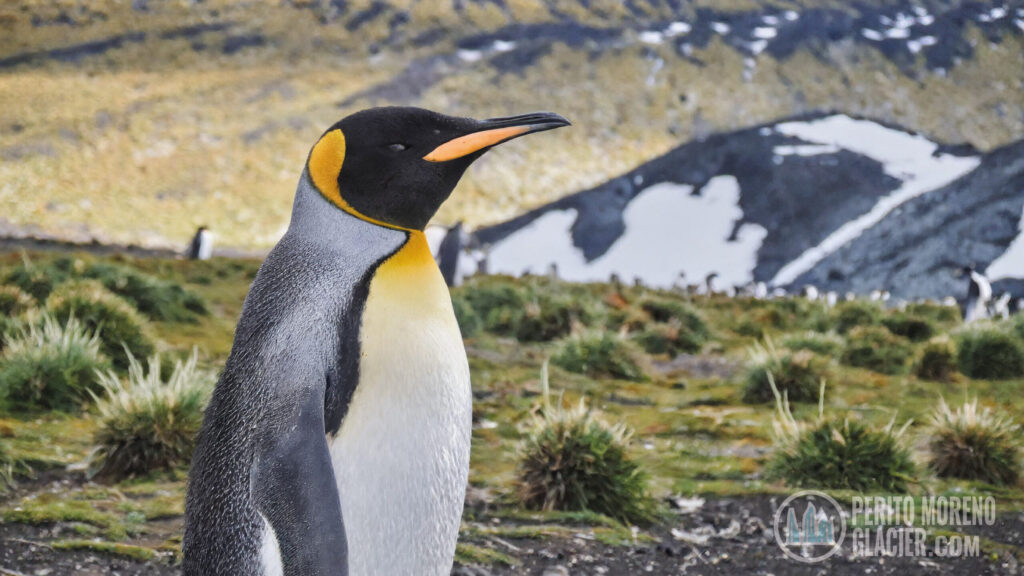
Its upper chest features a striking yellow-orange patch bordered by a black band, while its back is gray and downy, and its belly is white. The head is black with a long, slender bill showing orange on the sides. Its legs are perfectly adapted for swimming and diving in cold waters.
Juveniles are covered in soft brown down. In the wild, King Penguins can live up to 20 years, feeding mainly on krill, small fish, and other marine organisms.
Can I See King Penguins in Ushuaia?
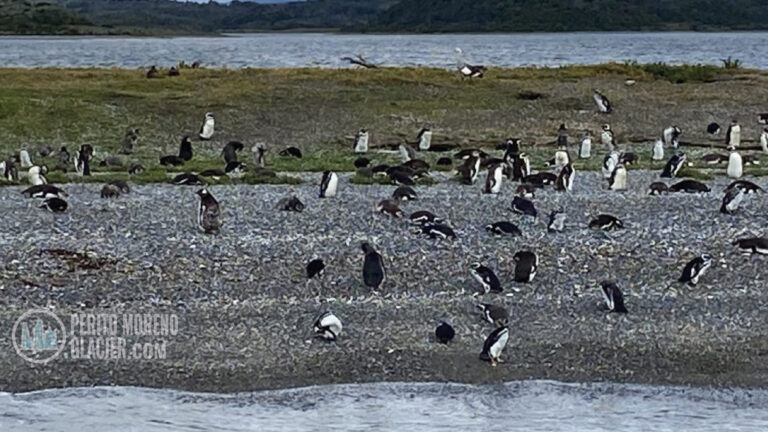
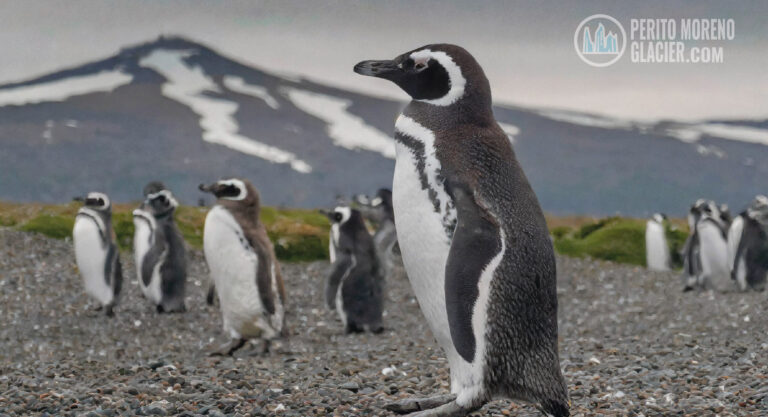
Occasionally, yes. Although King Penguins are not native breeders in the Ushuaia area, isolated individuals are sometimes spotted on Martillo Island. The island is primarily home to Magellanic and Gentoo Penguins, but a few King Penguins have been observed visiting the colony in recent years.
Visitors can join a guided tour from Ushuaia to Martillo Island and Harberton Ranch. Access is strictly regulated to protect the environment and the penguins’ habitat. If your goal is to see King Penguins with greater certainty, consider visiting Bahía Inútil’s Parque Pingüino Rey on the Chilean side of Tierra del Fuego.
Book a Beagle Channel Navigation to See Penguins and Visit Harberton Ranch
Click below to book a boat navigation from Ushuaia that includes Martillo Island’s penguin colonies and a visit to the historic Estancia Harberton. You’ll enjoy a unique wildlife experience surrounded by the breathtaking landscapes of Tierra del Fuego.
Beagle Channel Navigation: Sea Lions Island + Martillo Island Penguin Rookery
Enjoy a wonderful Beagle Channel Navigation from Ushuaia including the penguin rookery of Martillo Island