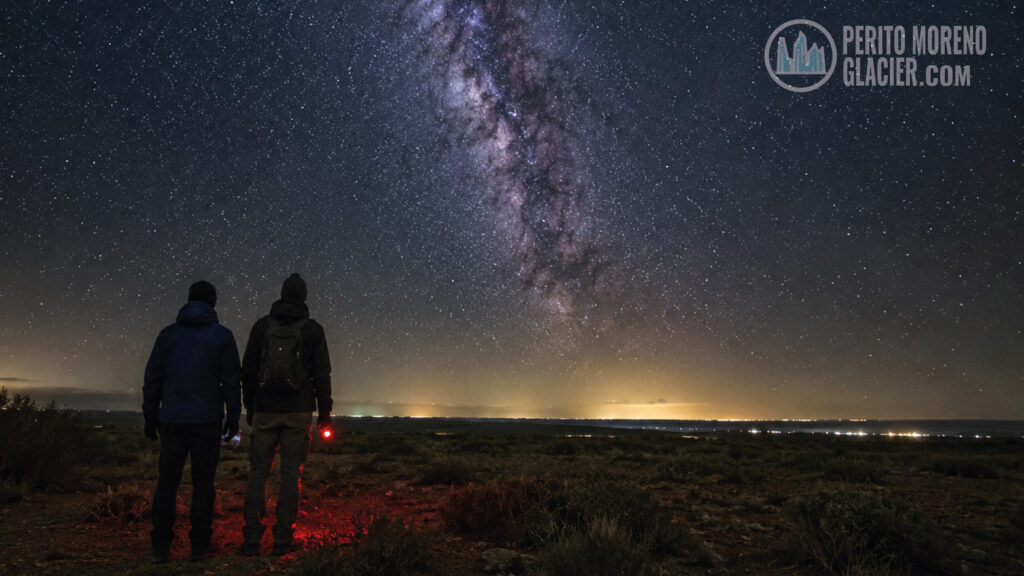
El Calafate is usually planned around daylight: the drive to Perito Moreno Glacier, the walkways, boat trips and the open landscapes of the Patagonian steppe. Yet one of the region’s most memorable natural experiences begins after those excursions are over. On a clear night, away from streetlights and with the Moon in the right phase, the southern sky can reveal the Milky Way, the Southern Cross, the Magellanic Clouds and a field of stars that looks very different from what many North American travelers see at home.
Good stargazing in El Calafate is not simply a matter of stepping outside after dinner. Sunset is not the same as full darkness, summer nights begin surprisingly late, the Moon can wash out faint detail, and Patagonia’s wind can affect both comfort and photography. This guide explains how to plan around those variables, what you may see and how to choose a safe observation place without duplicating the broader weather and daylight information already covered elsewhere in our Travel Guide.
Is El Calafate Good for Stargazing?
Yes—when the conditions cooperate. El Calafate sits in the sparsely populated Patagonian steppe, far from the light domes of major metropolitan areas. The dry landscape and wide horizons can create excellent opportunities for observing the night sky. Argentina’s national tourism organization specifically identifies El Calafate as a destination for stargazing hikes, astrophotography and guided astronomy activities.
The important qualification is location. The town itself has hotels, shops, vehicle traffic and street lighting. You can still see bright stars and planets from El Calafate, but the more delicate structure of the Milky Way and the faint Magellanic Clouds become easier to recognize after moving away from direct artificial light.
You also need a clear sky. Patagonia can be cloudless one hour and covered the next, and a strong wind can make a long outdoor session uncomfortable even when visibility is good. Treat stargazing as a weather-dependent activity and keep a second night available whenever your itinerary allows it.
My practical advice: after more than 25 years planning trips in Patagonia, I have learned that travelers often check the sunset time but forget to check when the sky becomes fully dark. In December, that difference can move a stargazing plan from after dinner to close to midnight.
The Three Conditions That Matter Most
1. Darkness, Not Just Sunset
The Sun continues illuminating the atmosphere after it drops below the horizon. Civil twilight is useful for walking, nautical twilight is darker, and astronomical twilight is the final stage before full night.
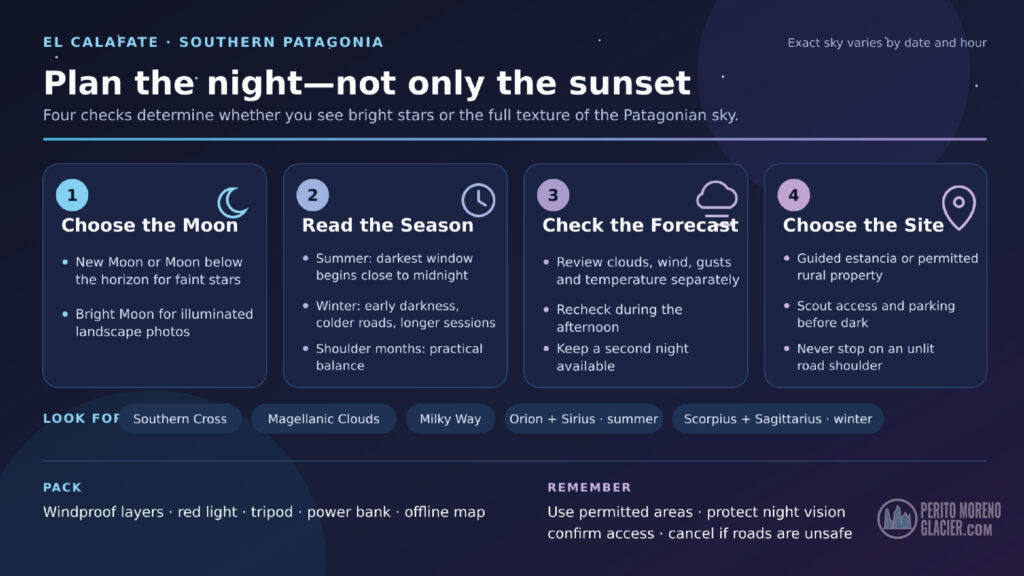
Around the December solstice, El Calafate has roughly 16 hours and 26 minutes of daylight. Sunset occurs close to 10:00 p.m., and the darkest part of the night begins much later. Around the June solstice, daylight falls to about eight hours, sunset is close to 6:00 p.m., and full darkness arrives early in the evening.
This does not automatically make winter the best season for every traveler. Longer nights come with lower temperatures, possible snow or ice, and more demanding road conditions. Summer is easier for most daytime activities, but anyone planning astronomy must be prepared to stay awake later.
2. The Moon
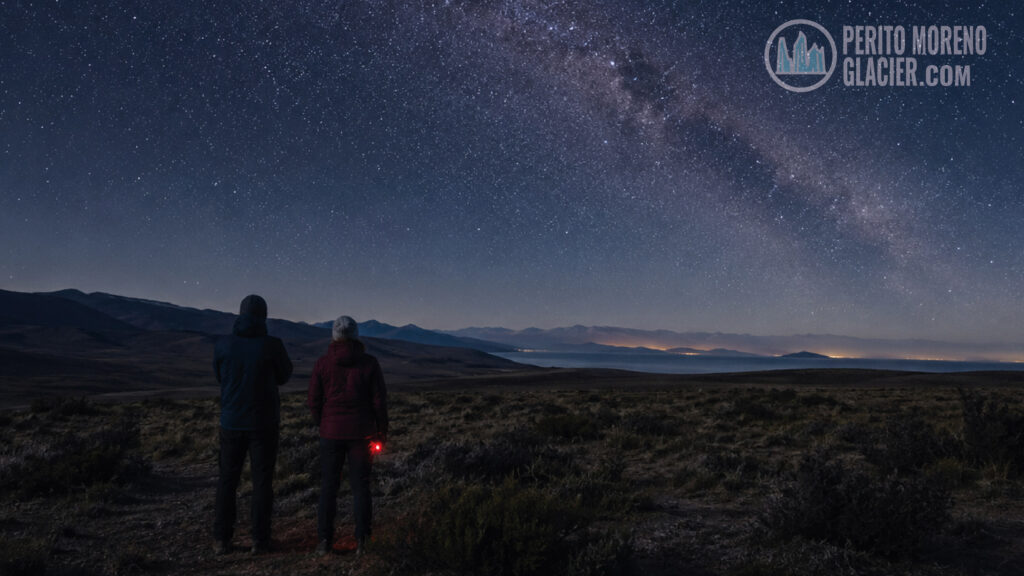
The Moon is the most overlooked part of a stargazing plan. A bright full Moon illuminates the landscape beautifully, but its glow reduces contrast and hides many faint stars. For the darkest sky and the clearest view of the Milky Way, plan around a new Moon or choose hours when the Moon is below the horizon.
A bright Moon is not a failed night. It changes the objective. Full- or quarter-Moon conditions can work well for photographing the steppe, mountains or a person under a naturally illuminated sky. They are simply less suitable for faint deep-sky detail.
3. Clouds and Wind
Cloud cover determines whether the sky is visible; wind determines how long you will want to remain outside and whether a tripod will stay stable. Check an hourly forecast rather than relying on a daily weather symbol. Look separately at cloud percentage, wind speed, gusts and temperature.
If your schedule is flexible, make the final decision in the afternoon. In Patagonia, that is more useful than committing several days in advance to one specific night.
Best Time of Year for Stargazing in El Calafate
There is no single perfect month. The best period depends on whether you value long nights, easier temperatures, the Milky Way’s galactic center or a convenient travel schedule.
| Season | Typical stargazing conditions | Best for | Main trade-off |
|---|---|---|---|
| December to February | Very long daylight; full darkness begins late | Travelers already visiting in peak summer; Orion, Sirius and bright southern objects | Short observing window and a very late start |
| March to April | Nights lengthen and darkness arrives at a more practical hour | A balance between sightseeing and astronomy | Weather remains changeable and nights become cold |
| May to August | Longest nights and early darkness | Milky Way core season, extended observation and night photography | Cold, ice, snow and more demanding transport conditions |
| September to November | Nights gradually shorten as spring advances | Shoulder-season itineraries and early-evening Milky Way opportunities | Increasingly late darkness toward November |
For many visitors, March, April, September and October offer the most practical balance. Winter provides the longest observing sessions, while summer works if you accept a late start.
For broader temperature, rainfall and daylight information, use our Weather in El Calafate and Perito Moreno Glacier Area guide. It explains the annual climate in detail; this article focuses specifically on how those conditions affect night-sky observation.
What Can You See in the Patagonian Night Sky?
The exact sky changes with the date and hour, so no article can replace a current planetarium app. Still, several southern-sky landmarks are particularly relevant in El Calafate.
The Milky Way
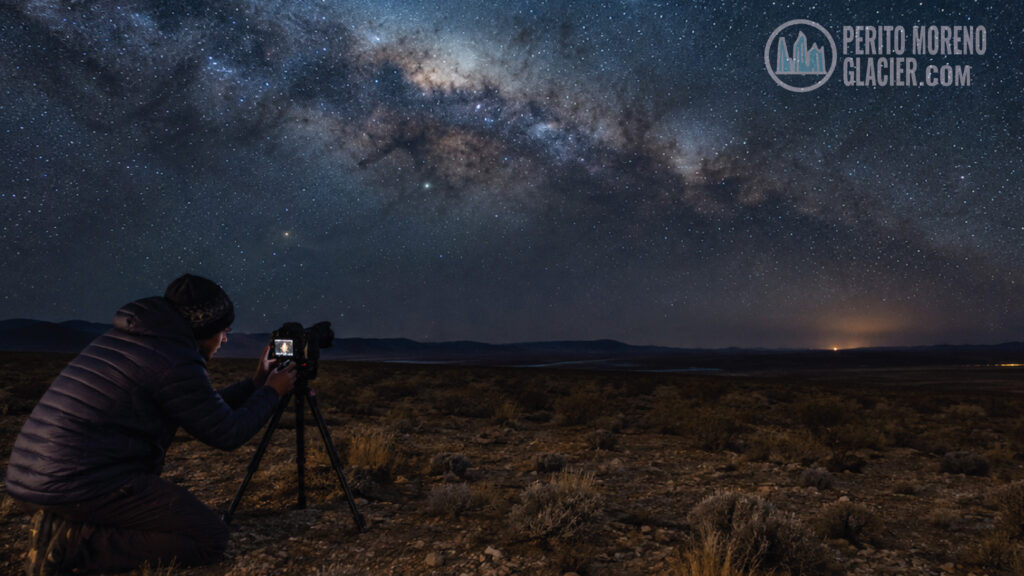
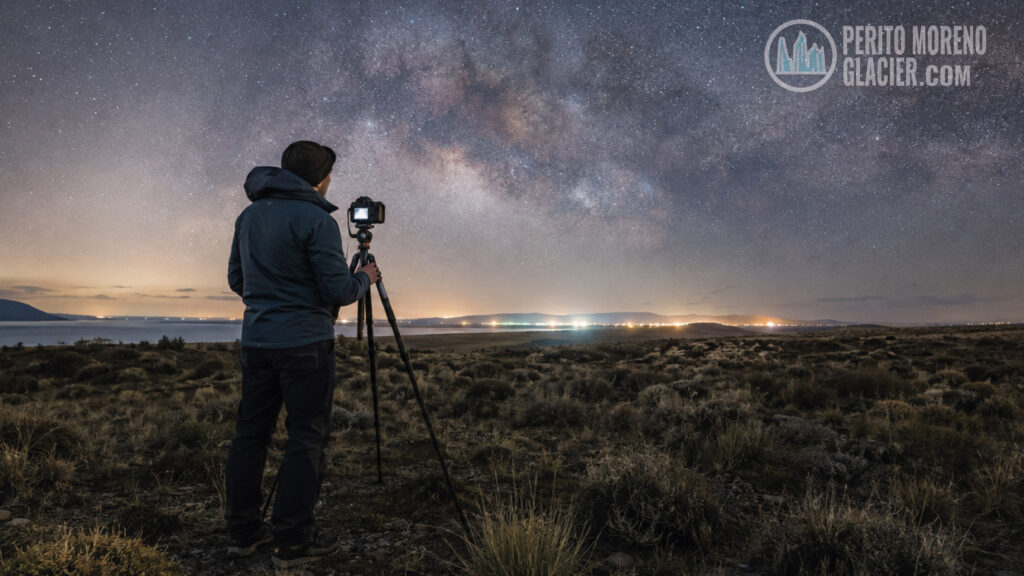
From a genuinely dark location, the Milky Way appears as a pale, textured band rather than the saturated colors shown in long-exposure photographs. The camera records more light and color than the human eye, so expectations matter.
The brighter galactic center lies in the direction of Sagittarius and Scorpius. In the Southern Hemisphere it is generally most practical to observe and photograph from late summer through spring, with especially convenient evening opportunities during autumn and winter. Its position and viewing time shift from month to month; check the exact date before choosing a location or foreground.

Big Ice Trekking on Perito Moreno Glacier From El Calafate
Join our Big Ice Trekking Tour on Perito Moreno Glacier. Explore ice formations & rugged beauty. Book now for an unforgettable experience.
The Southern Cross and the Coalsack
Crux, better known as the Southern Cross, is one of the easiest southern patterns to learn. Nearby, the dark Coalsack Nebula appears as a shadow against the brighter Milky Way when the sky is sufficiently dark. Alpha and Beta Centauri act as bright “pointer” stars in the same broad region of sky.
The Southern Cross also helps observers understand the direction of the south celestial pole. It does not point to a bright southern equivalent of Polaris, so using a sky app or having a guide explain the geometry makes the first identification much easier.
The Large and Small Magellanic Clouds
The Magellanic Clouds are two nearby satellite galaxies of the Milky Way. To the naked eye they look like detached, softly glowing patches—not conventional clouds and not sharply defined objects. They are particularly rewarding for travelers who have spent most of their lives observing from the Northern Hemisphere.
They require a dark sky, adapted vision and limited moonlight. Look slightly beside them rather than directly at the faintest area; peripheral vision often detects dim objects more effectively.
Orion, Sirius, Scorpius and Sagittarius
Orion and Sirius are prominent during the austral summer, although their orientation may feel unfamiliar to visitors from the United States. Scorpius and Sagittarius become important during the longer autumn and winter nights and guide the eye toward the Milky Way’s central region.
Planets add another layer, but their visibility changes from year to year. Use an updated astronomy app for your exact travel date instead of relying on a permanent list.
Where to Go Stargazing Around El Calafate
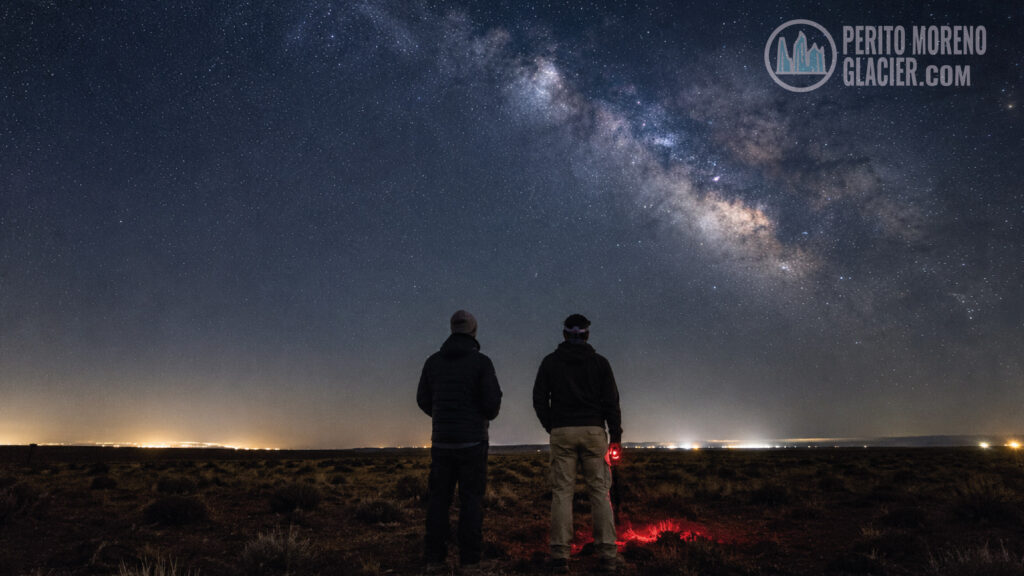
The best site is not necessarily the most remote. It is the darkest place you can reach legally, safely and comfortably.
A Guided Astronomy Experience
Official Patagonia tourism information confirms that El Calafate offers guided night outings with an astronomer, sometimes combined with dinner at a rural estancia. A guided experience is the simplest option if you do not have a vehicle or telescope, are unfamiliar with the southern sky, or prefer not to navigate rural roads at night.
Operating days, pickup arrangements, equipment and weather policies can change. Confirm the exact program for your date rather than assuming every departure runs year-round.
A Rural Hotel or Estancia
Accommodation outside the town center may provide enough open space and reduced lighting for casual observation. Ask the property whether guests may use the grounds at night, whether exterior lights can be avoided, and which areas are safe around livestock, fences and uneven ground.
This can be a better choice than driving farther into the steppe because you remain on permitted property and can return indoors quickly if the weather changes.
Independent Observation
If you plan to go independently, identify the location during daylight. Use established parking or viewing areas, obtain permission on private land and confirm that the route remains open at night.
Do not stop on an unlit highway shoulder, cross fences, enter an estancia without permission or assume that Los Glaciares National Park remains accessible after normal visiting hours. Stargazing near Perito Moreno Glacier should only be considered as part of an authorized activity or when current park access explicitly permits it.
| Option | Main advantage | Consider before choosing |
| Guided outing | Astronomer, transport and equipment may be included | Confirm operating schedule and weather policy |
| Rural accommodation | Easy access and a quick return indoors | Ask about lighting, permission and safe areas |
| Independent site | Maximum flexibility for timing and photography | Requires transport, daylight scouting and stronger safety planning |
How to Plan the Night Step by Step
Check the Moon Before the Weather
Start with a lunar calendar. If your priority is the Milky Way, identify nights near the new Moon or periods when the Moon sets before your observing session. Then check when astronomical twilight ends.
Review the Hourly Forecast
On the day itself, compare cloud cover, wind, gusts and temperature. A forecast showing clear conditions for only one or two hours may still be useful if you are already close to a dark location.
Choose the Site in Daylight
Look for secure parking, level ground, a clear horizon and protection from direct lights. Note fences, ditches, loose gravel and livestock. Download offline directions because mobile coverage can weaken outside town.
Allow Your Eyes to Adapt
It takes time for your vision to adjust to darkness. Avoid white phone screens and bright flashlights. Use a dim red light, lower the phone brightness and activate a red-screen mode if your astronomy app provides one.
Keep the Session Simple
Begin with the naked eye. Find the Milky Way, Southern Cross and brightest stars before using binoculars or a telescope. People often spend so much time adjusting equipment that they forget to understand the overall sky.
What to Bring
Night temperatures can feel significantly colder than the afternoon forecast, especially when you are standing still.
- Insulating base and mid layers
- Windproof outer jacket
- Warm hat and gloves
- Thermal socks and closed footwear
- Headlamp with a red-light setting
- Fully charged phone and power bank
- Offline map and astronomy app
- Hot drink and water
- Compact blanket or insulated seat pad
- Binoculars, if available
- Camera tripod and spare battery for photography
For a complete daytime and seasonal clothing list, see What to Pack to El Calafate, Argentina. Add extra insulation for stargazing because inactivity and wind increase heat loss.
Astrophotography in El Calafate
Using a Smartphone
Modern phones can record more stars than you may expect if they remain perfectly still.
- Use Night mode or the phone’s low-light setting.
- Mount the phone on a tripod or brace it securely.
- Use a timer or remote shutter to avoid vibration.
- Avoid digital zoom.
- Include a simple foreground such as the steppe horizon, a fence line or a silhouette.
- Make several exposures and compare them before leaving the location.
A phone image will not look identical to a professional stacked exposure, but it can record the atmosphere of the night convincingly.
Amazing Patagonia: Ushuaia, El Calafate & Torres del Paine National Park
Book this amazing tour including Ushuaia, El Calafate, and the unique Torres del Paine National Park
Using a Mirrorless or DSLR Camera
Treat these settings as a starting point, not a formula:
- Wide-angle lens
- Widest practical aperture
- Manual exposure
- Approximately 10–20 seconds to begin
- ISO adjusted according to the camera, often between 800 and 3200
- Manual focus checked on a bright star using magnified live view
- RAW capture when available
Take a test photograph, zoom in and inspect the stars. If they appear as small lines, shorten the exposure. If the image is too dark, open the aperture or raise the ISO before lengthening the shutter excessively.
Patagonian wind is the extra challenge. Keep the tripod low, close the thinnest leg sections first and avoid hanging a bag where it can swing. Shield the camera with your body without touching it during the exposure.
Big Ice Trekking on Perito Moreno Glacier From El Calafate
Join our Big Ice Trekking Tour on Perito Moreno Glacier. Explore ice formations & rugged beauty. Book now for an unforgettable experience.
Responsible and Safe Stargazing
A dark landscape is also a working rural environment and wildlife habitat.
- Use existing roads, parking areas and permitted paths.
- Do not cross fences or enter private land without permission.
- Keep voices and music low near wildlife and livestock.
- Use the minimum light required for safety.
- Never stand or park on an active roadway.
- Take all waste back with you.
- Tell your hotel or another person where you are going and when you expect to return.
- Carry warm clothing even when the afternoon felt mild.
- Cancel or relocate the plan if wind, ice or visibility makes the route unsafe.
Cabalgata Experience: Canyon and Horseback Riding
Ride through Patagonia’s canyons, discover gaucho history, and enjoy a countryside lunch at Estancia 25 de Mayo.
Guided Stargazing or Going Independently?
Choose a guided outing if this is your first experience with the southern sky, you do not have transport, or you want a telescope and an astronomer’s interpretation. Go independently if photography timing is your main priority, you already understand night navigation and you have confirmed a safe, permitted site.
In my experience, the deciding factor is not astronomy knowledge but logistics. A traveler may know exactly where the Milky Way will rise and still have a poor night if the parking place is exposed, the wind is stronger than expected or the return route is unfamiliar.
If you want to add a guided astronomy evening to an El Calafate itinerary, contact our team with your dates. Availability and operating conditions should always be reconfirmed for the specific night.
Frequently Asked Questions
Can You See the Milky Way from El Calafate?
Yes, but the result depends on darkness, cloud cover, moonlight and location. From the town center you will mainly see brighter stars. For the Milky Way’s textured band and central region, move away from direct artificial light and plan for a moonless period.
What Is the Best Month for Stargazing in El Calafate?
There is no universal best month. March, April, September and October provide a useful balance for many travelers. Winter offers the longest nights and strong Milky Way opportunities but requires more preparation for cold and road conditions.
Do I Need a Telescope?
No. The Milky Way, Southern Cross, bright stars and Magellanic Clouds can be observed with the naked eye under suitable conditions. Binoculars add detail and are easier for beginners than a telescope.
Does a Full Moon Ruin Stargazing?
It reduces the visibility of faint stars and the Milky Way, but it can be excellent for moon observation and illuminated landscape photography. Match the plan to the lunar phase rather than automatically canceling.
Can I Stargaze at Perito Moreno Glacier After Dark?
Do not assume so. Park access, roads, gates and operating hours must be confirmed. Only enter after normal hours through an authorized activity or when current official access rules explicitly allow it.
How Late Does Stargazing Start in Summer?
Near the December solstice, sunset is close to 10:00 p.m. and true darkness arrives much later, close to midnight. Check the astronomical-twilight time for your exact date.
What Can I Do If the Night Is Cloudy?
Keep a second possible night in your itinerary. If the sky remains closed, use our guide to Nightlife in El Calafate for indoor and evening alternatives.
Final Planning Perspective
Stargazing in El Calafate works best when it is treated as a small expedition rather than an automatic evening activity. Choose the Moon phase, calculate true darkness, review the hourly wind and cloud forecast, and select the location before sunset. Those steps require little time, but they determine whether you see only a few bright stars or begin to understand the southern sky as part of the Patagonian landscape.
Big Ice & Estancia Cristina Adventure – 3 Nights
Enjoy visiting Perito Moreno Glacier, walking over the ice of the glacier and a wonderful trekking or horseback riding in a remote estancia in the national park

El Calafate, Perito Moreno Glacier Ice Trekking and 2-night Luxury Glacier Cruise
4 nights in the glaciers area to enjoy Perito Moreno Glacier and the incredible Spirit of the Glacier Cruise in a 2-day boat navigation