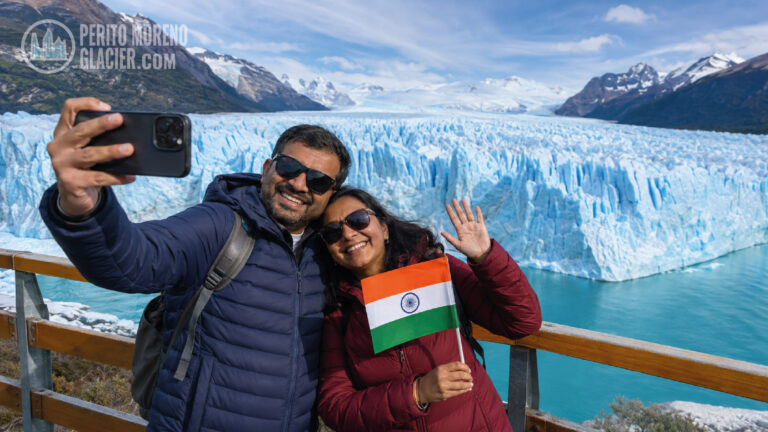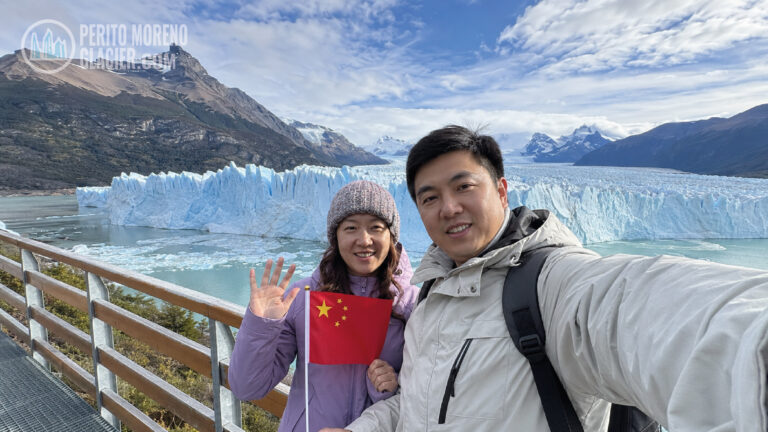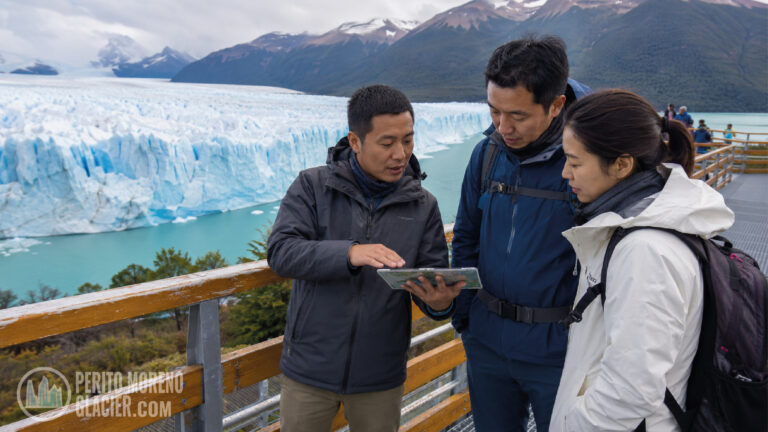
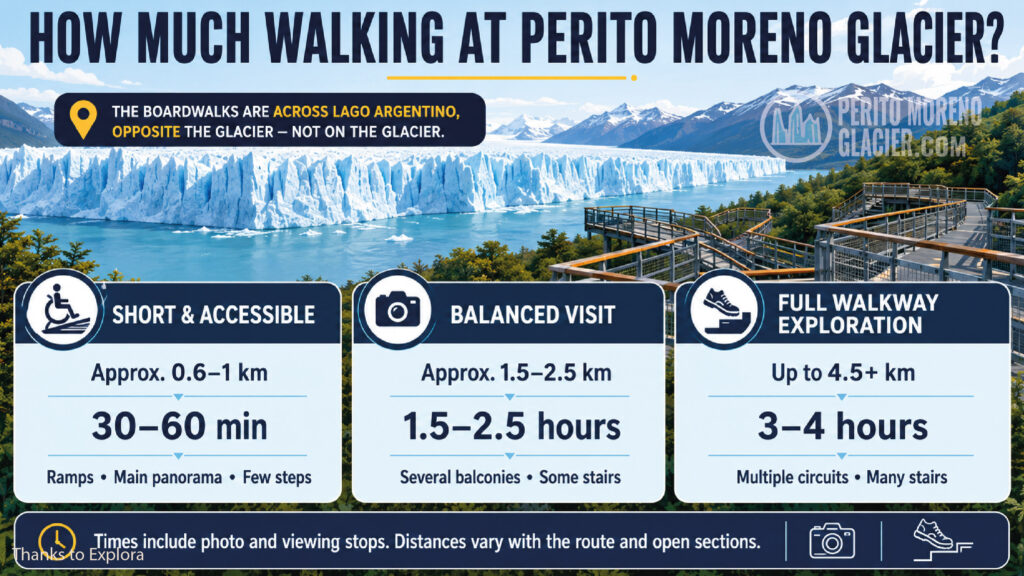
The short answer is: you can see Perito Moreno Glacier with less than 1 km (0.6 miles) of walking, or spend several hours exploring more than 4.5 km (2.8 miles) of interconnected walkways. The amount you walk is largely your choice.
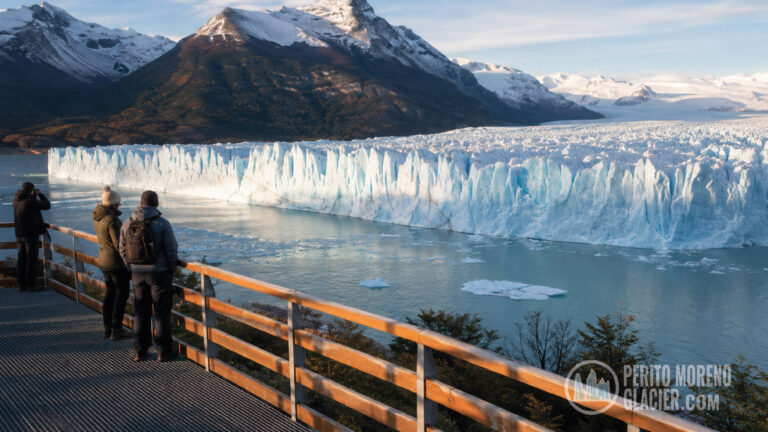
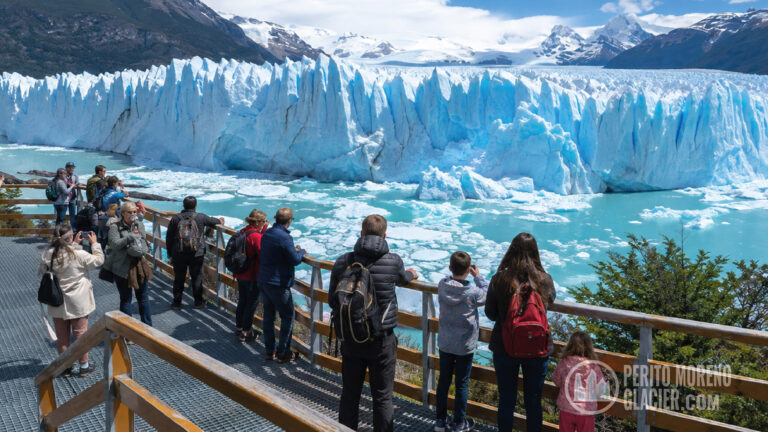
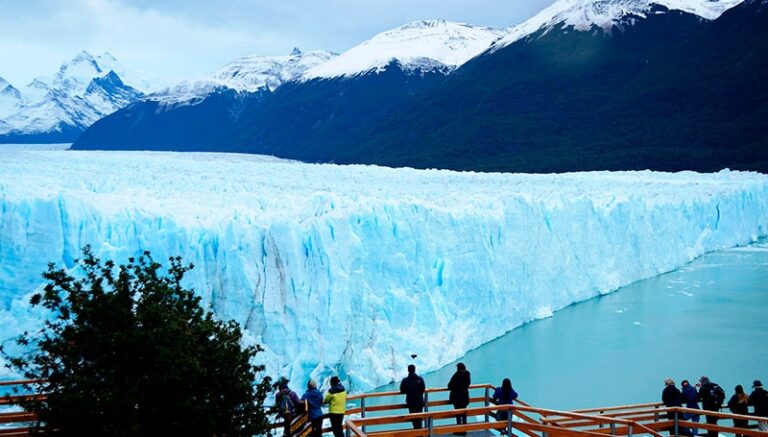
Unlike many famous glaciers, Perito Moreno does not require a mountain hike just to obtain a superb view. Its visitor area has a network of elevated metal walkways and viewing balconies on the Magallanes Peninsula, directly opposite the glacier’s terminal face. A short, accessible route reaches one of the classic panoramas, while longer circuits descend through the Patagonian forest and reveal the ice from different heights and angles.
This guide focuses specifically on walking distance, time, stairs, route planning and viewpoints. It does not repeat the broader information found in our general Perito Moreno Glacier guides about transport, park tickets, boat excursions or ice-trekking programs.
Important: The distances and times below are practical planning estimates. Open sections, access points and suggested circulation may change because of maintenance, weather or park operations. Always follow the signs and ranger instructions you find on the day of your visit.
Complete Tour to Perito Moreno Glacier: Boat Navigation & Lunch
Enjoy a Perito Moreno Glacier tour from el Calafate in a full day, with lunch and boat navigation included
How Much Walking Is There at Perito Moreno Glacier?
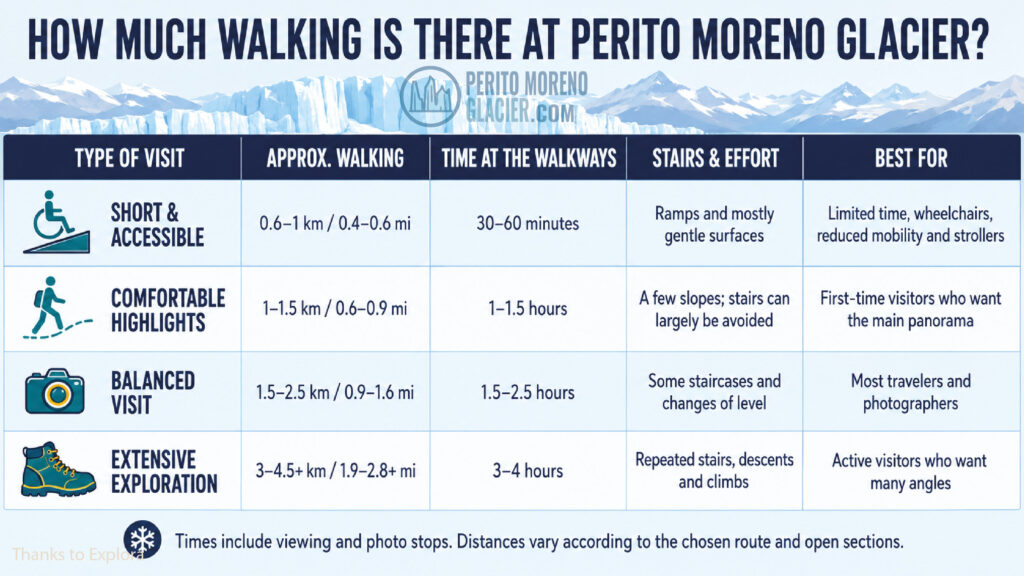
The official visitor network extends for more than 4.5 km (2.8 miles), but that figure represents the system of walkways and viewpoints—not a compulsory point-to-point hike. Most visitors choose only part of it.
| Type of visit | Approximate walking | Realistic time at the walkways | Stairs and effort | Best for |
|---|---|---|---|---|
| Short and accessible | 0.6–1 km / 0.4–0.6 mi | 30–60 minutes | Ramps and mostly gentle surfaces | Limited time, wheelchairs, reduced mobility, families with strollers |
| Comfortable highlights | 1–1.5 km / 0.6–0.9 mi | 1–1.5 hours | A few slopes; stairs can largely be avoided | First-time visitors who want the main panorama |
| Balanced visit | 1.5–2.5 km / 0.9–1.6 mi | 1.5–2.5 hours | Some staircases and changes of level | Most travelers and photographers |
| Extensive exploration | 3–4.5+ km / 1.9–2.8+ mi | 3–4 hours | Repeated stairs, descents and climbs | Active visitors who want many angles |
These times deliberately include pauses. Perito Moreno is not a place most people walk through without stopping: you will wait for possible calving, listen to the ice, take photographs and return to a balcony when the light changes.

Is the Walking Difficult?
The surfaces are constructed, maintained and clearly defined, so this is not technical hiking. You do not need trekking experience for the panoramic walkways. However, the complete network can feel more demanding than the distance suggests because it contains many steps and repeated changes in elevation.
The easiest sectors are suitable for a broad range of visitors. The lower and more extensive routes demand better knee mobility and more stamina, especially when you must climb back to the upper visitor level. Wind, rain, ice or snow can also make a normally easy outing feel slower.
Does the Walk Take Place on the Glacier?
No. The panoramic walkways are on solid ground, across the water from the glacier. They should not be confused with a guided ice trek, which requires a separate excursion, boat transfers, specialist equipment and eligibility requirements.
If your main concern is how much ordinary walking a classic sightseeing visit involves, use the distances in the table above. An ice-trekking program is a different activity and adds considerably more walking and time.
Argentinian & Chilean Patagonia: Ushuaia, El Calafate, El Chalten and Puerto Natales
Enjoy visiting Ushuaia and the end of the world... El Calafate and Perito Moreno Glacier... El Chalten and the Fitz Roy Mount and Puerto Natales and Torres del Paine National Park!
Understanding the Perito Moreno Glacier Walkways
The walkway system is often described by colors on local maps and signs. Names and route presentation can vary between maps, so it is more useful to understand the landscape in three levels rather than memorize a color before arriving.
The Upper and Accessible Sector
This is the most efficient area for a first view. Ramps lead to broad balconies with an elevated panorama of the glacier, Canal de los Témpanos and the surrounding mountains. It provides a strong sense of scale with the least physical effort.
Choose this sector if you have limited time, use a wheelchair, travel with a stroller or prefer to minimize stairs. Accessible does not mean visually inferior: this is one of the most complete views in the entire complex.
The Central Balconies
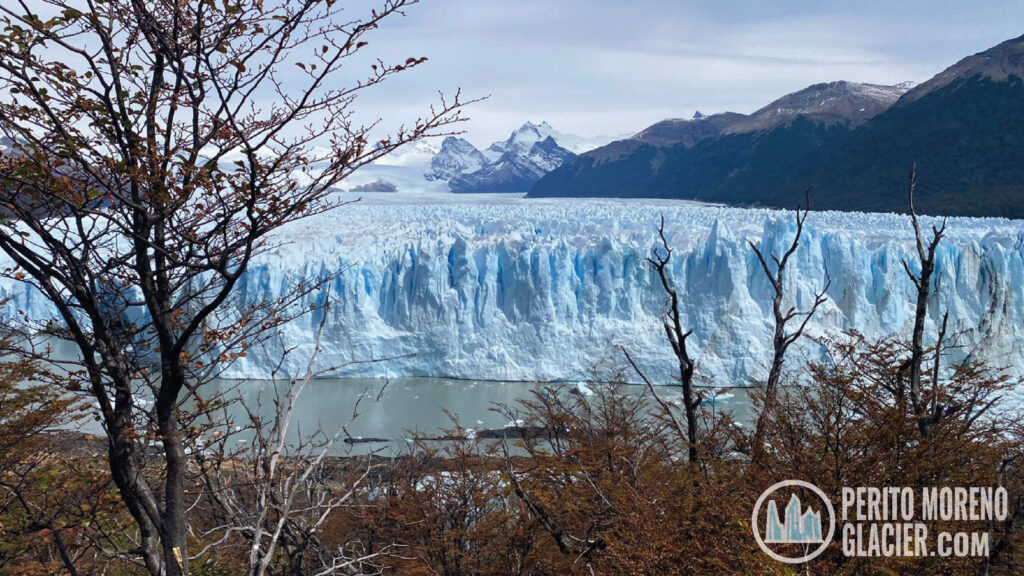
The central area places you more directly opposite the glacier’s terminal face. Several balconies sit at different heights, changing the relationship between foreground forest, lake and ice.
For many visitors, this is the best compromise. It gives the iconic frontal view and a selection of perspectives without requiring the full network. Allow time to remain still here—the sound of a fracture often arrives after the movement becomes visible.
The Lower and Forest Walkways
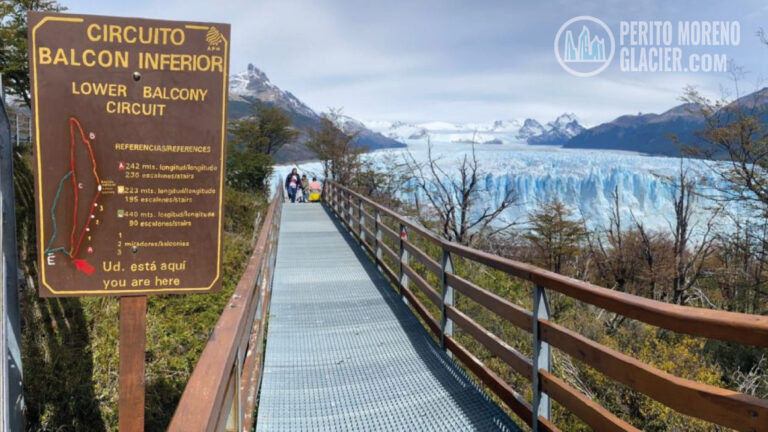
The lower routes descend through lenga woodland toward balconies closer to water level. The glacier appears taller and more imposing because you are seeing it from a lower angle. These sectors also create more varied compositions for photographs, with branches, shoreline and lake in the foreground.
They involve more stairs and require a climb back. Visitors with knee problems should treat the descent as optional rather than assuming that every circuit must be completed.
The Best Viewpoints at Perito Moreno Glacier
There is no single “best” balcony for everyone. The most rewarding viewpoint depends on whether you want the classic panorama, a dramatic wall of ice, good photographic light or step-free access.
1. Best Overall View: The Main Central Balcony
If you visit only one viewpoint, choose a central balcony directly opposite the glacier. This is the signature Perito Moreno perspective: an extensive section of the terminal face, the lake on both sides of the ice and the Andes behind it.
It is especially valuable for a first-time visitor because it immediately explains the glacier’s scale and position. It is also one of the best places to wait for a calving event, although no viewpoint can guarantee one.
2. Best Panoramic View: The Upper Balconies
The upper sector gives the widest geographic context. From here, the glacier reads as a huge river of ice flowing out of the mountains rather than only as a vertical wall.
This is usually the strongest choice for wide-angle photographs, group pictures and days when low cloud still leaves the foreground visible. It is also the logical first stop because it helps you orient yourself before descending.
3. Best View for Feeling the Glacier’s Height: The Lower Balconies
From the lower levels, the ice front seems to rise more dramatically above the water. The view is less map-like and more immersive. Floating ice and the movement of the lake also become more noticeable.
This is an excellent choice if your priority is the physical presence of the glacier. The trade-off is extra stair climbing and a narrower view than from above.
4. Best Accessible Viewpoint: The Ramp-Connected Upper Platform
The accessible route offers a genuine headline view rather than a secondary alternative. Visitors who cannot use steps can still see the glacier face, lake and mountain backdrop from a well-positioned platform.
Accessibility can be affected temporarily by weather or maintenance, so travelers with specific mobility requirements should confirm current conditions before departure. On site, ask staff for the most direct ramp-only route and the appropriate drop-off or parking arrangement.
El Calafate Tour Package: 1–3 Nights
Enjoy visiting Perito Moreno Glacier and other amazing attractions in the area. Choose between our 1-2-3 night packages and discover Patagonia
5. Best Viewpoint for Photography: A Mid-Level Balcony
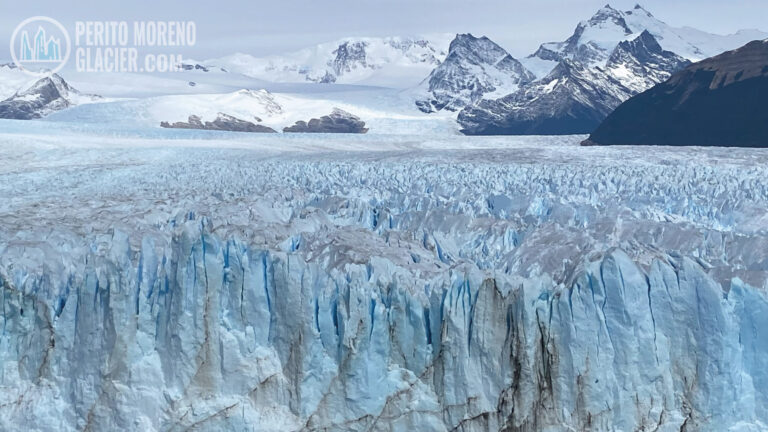
A mid-level balcony often gives the most balanced composition: enough height to see the glacier’s surface, but enough proximity to preserve the scale of its vertical face. It can also include forest or walkway lines in the foreground.
For photography, do not rush to the lowest possible point. Walk down one level, compare the angle, and stop where the glacier fills the frame without losing the mountains behind it. A moderate telephoto lens is useful for ice details; a phone or wide-angle lens works well for the full setting.
6. Best Quiet View: A Side Balcony Away from the Main Hub
The busiest platform is not always the most memorable. Continue along one of the lateral walkways and look for a smaller permitted balcony away from the restaurant and main arrival point. Even a few minutes of extra walking can reduce crowd noise.
These side angles are particularly good for watching the meeting point between ice, forest and water. Conditions and open sections vary, so follow the marked routes rather than seeking an unofficial viewpoint.
A Smart Walking Route for First-Time Visitors
For most travelers, the ideal strategy is not to attempt every meter. Use a top-to-bottom approach and turn around when you have seen enough variation.
Step 1: Begin with the Upper Panorama
Take in the full scene before concentrating on details. This first stop also lets you assess the wind, visibility and your energy level.
Step 2: Move to the Main Central View
Spend at least 15–20 minutes facing the central part of the ice front. Calving is unpredictable; walking constantly can actually reduce your chance of noticing it.
Step 3: Descend One Level
Try one mid-level or lower balcony. If the change in angle is rewarding and the stairs feel comfortable, continue. If not, return without feeling that you missed the essential experience.
Step 4: Add a Lateral or Forest Section
Use your remaining time for a quieter side view rather than repeating similar central balconies. This creates more variety with a manageable total of approximately 1.5–2.5 km.

How Long Should You Spend at the Walkways?
If You Have One Hour
Stay on the upper and central accessible sectors. You can obtain the classic view and take photographs, but keep an eye on your transport departure time. One hour is enough for a meaningful visit, not for broad exploration.
If You Have Two Hours
This is the sweet spot for many visitors. Combine the upper panorama, central balconies and one lower or lateral section. You should be able to pause rather than merely pass through.
If You Have Three to Four Hours
Explore several circuits, take a rest and revisit the best balcony as the light or clouds change. A longer stay increases your opportunity to witness natural ice movement, although a major calving event is never guaranteed.
Walking with Children, Seniors or Reduced Mobility
Families with Babies or Toddlers
Use a stroller only on the ramped and accessible areas. Many lower sectors contain stairs, making a lightweight carrier more practical if you intend to explore beyond the upper platforms. Keep children close: the structures are protected, but wind can be sudden and the area becomes busy.
Seniors and Visitors with Knee Problems
Prioritize the upper and central views and be conservative about descending. Going down may feel easy; returning up the same elevation is the demanding part. Benches and viewing stops make it possible to divide the walk into short stages.
Wheelchair Users
An accessible route serves panoramic viewpoints, but not every walkway is step-free. Ask for the current accessible circuit when you arrive and never assume that a color shown on an old online map reflects today’s exact circulation.
What Makes the Walk Feel Longer?
Distance alone does not tell the full story. Several factors can alter your pace:
- Stairs: The lower circuits include repeated flights rather than one continuous slope.
- Patagonian wind: Strong gusts slow walking and make exposed balconies feel colder.
- Wet or icy surfaces: Rain, frost and snow require shorter, more careful steps.
- Photography: The same glacier looks different from every elevation, encouraging frequent stops.
- Calving: After hearing the ice crack, most visitors wait to see whether a block will fall.
- Crowds: Busy platforms may require patience, particularly around midday in high season.
El Calafate Special Adventure Program: Big Ice and Horseback Riding or Trekking in Estancia Cristina
Enjoy visiting Perito Moreno Glacier, walking over the ice of the glacier and a wonderful trekking or horseback riding in a remote estancia in the national park

Practical Tips for a Comfortable Walk
- Wear closed shoes with a grippy sole. Heavy hiking boots are unnecessary for the standard walkways, but smooth fashion shoes are a poor choice.
- Dress in layers and carry a wind-resistant outer shell. Temperature on an exposed balcony can feel very different from El Calafate.
- Keep one hand free on stairways during strong wind.
- Carry water, but avoid overpacking; you will repeatedly climb and descend if completing longer routes.
- Photograph the current map or information panel at the entrance.
- Check your return or tour meeting time before descending to a distant balcony.
- Never leave the marked walkway, cross barriers or approach the shoreline in closed areas.
Perito Moreno Glacier Tour from El Calafate
Enjoy a Perito Moreno Glacier tour from el Calafate! One of Patagonia's most incredible shows: Perito Moreno Glacier.
Is It Worth Walking Every Circuit?
Only if you enjoy walking and have enough time. The complete network offers changing heights, forest scenery and quieter side perspectives, but the visual return is not proportional to every additional meter. The fundamental Perito Moreno experience is available from the upper and central balconies.
For a first visit, a balanced 1.5–2.5 km route over approximately two hours is usually more satisfying than rushing through the entire network. Active travelers and keen photographers can extend the walk to more than 4.5 km and spend three to four hours exploring.
Frequently Asked Questions
How far do you have to walk to see Perito Moreno Glacier?
You can reach an excellent panoramic view with approximately 0.6–1 km of walking, depending on your access point and exact route. You do not need to complete the full walkway network.
How long does it take to walk the Perito Moreno boardwalks?
A short visit takes 30–60 minutes, a balanced visit around 1.5–2.5 hours, and extensive exploration approximately 3–4 hours. Viewing and photo stops account for much of that time.
How long are the Perito Moreno Glacier walkways?
Argentina’s National Parks Administration describes a network of more than 4.5 km. Individual routes are shorter and can be combined in different ways.
Are there many stairs at Perito Moreno Glacier?
There are many stairs on the lower and longer circuits, but the main accessible sector uses ramps and allows visitors to enjoy a panoramic view while avoiding most or all steps.
Can you visit Perito Moreno Glacier without hiking?
Yes. The main views are reached on constructed walkways, not mountain trails. A short, accessible sightseeing visit is possible without undertaking a traditional hike.
Which is the best viewpoint at Perito Moreno Glacier?
The central balcony is the best all-around choice, the upper platforms provide the widest panorama, and the lower balconies create the most dramatic impression of the ice wall’s height.
Do I need a guide for the walkways?
No guide is required to follow the marked panoramic walkways. A guide can add geological and ecological interpretation, but the routes themselves are designed for independent visitors.
Final Recommendation
Plan for about two hours and 1.5–2.5 km of walking if this is your first visit. Start high, pause at the main central balcony, descend only as far as feels comfortable and add a side viewpoint for a quieter angle. This approach captures the best of Perito Moreno without turning a spectacular natural encounter into a race to complete every circuit.
Fact-check note for editors: The official National Parks source states that the walkway network exceeds 4.5 km and includes low-to-medium difficulty options, stairs and accessible alternatives. Route availability should be reconfirmed periodically because operational conditions can change.
Ushuaia, El Calafate and El Chalten in the Argentinian Patagonia – 8 Nights Tour Package
Enjoy visiting Ushuaia , the famous "end of the world city", el Calafate with Perito Moreno Glacier and unique trekking activities in El Chalten
El Calafate Special Adventure Program: Big Ice and Horseback Riding or Trekking in Estancia Cristina
Enjoy visiting Perito Moreno Glacier, walking over the ice of the glacier and a wonderful trekking or horseback riding in a remote estancia in the national park