Lago Argentino is famous for its turquoise water, immense Patagonian scenery and direct connection to some of the most impressive glaciers in Los Glaciares National Park. But the lake also contains another remarkable natural feature: floating icebergs produced by Perito Moreno, Upsala, Spegazzini and other glaciers.
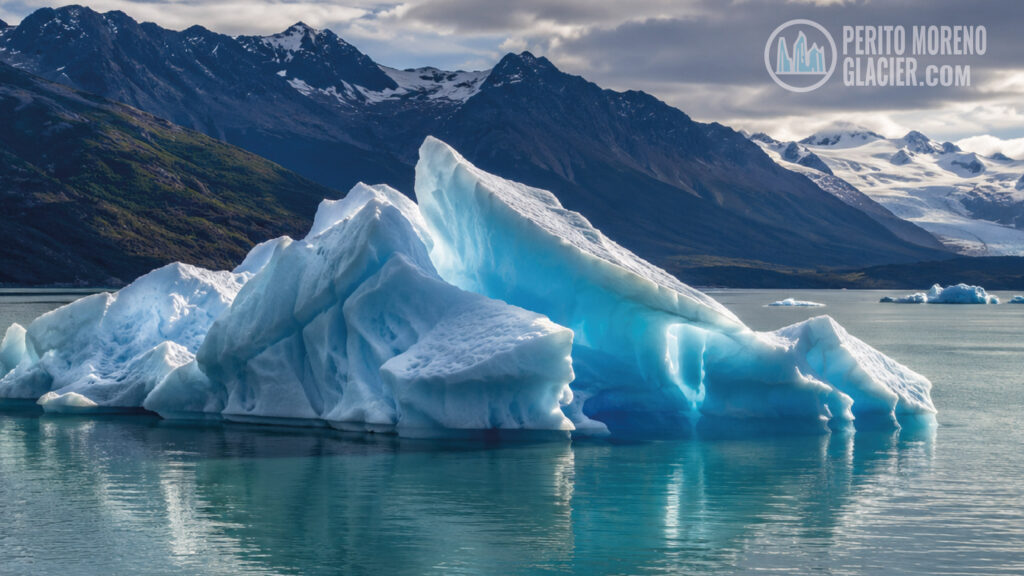
Some are no larger than a suitcase. Others resemble floating towers, arches or small islands. Their colors range from brilliant white to intense blue, sometimes crossed by dark sediment bands accumulated during the glacier’s journey through the mountains.
Unlike ocean icebergs associated with Antarctica or Greenland, the icebergs of Lago Argentino float in a freshwater glacial lake. They are constantly changing, drifting, rotating, fracturing and melting. No two visits offer exactly the same landscape.
What Are the Icebergs of Lago Argentino?
An iceberg is a piece of glacier ice that has broken away from a glacier and entered a body of water. This process is called calving.
In Lago Argentino, icebergs originate primarily from glaciers descending from the Southern Patagonian Ice Field. These glaciers transport compacted snow and ancient ice from the Andes toward the lake.
When the moving ice reaches the water, sections of the glacier front may detach and become free-floating icebergs.
The UNESCO description of Los Glaciares National Park highlights precisely this relationship between glaciers and lakes: the glaciers feed Lago Argentino and Lago Viedma, while the front of Perito Moreno regularly calves bluish icebergs into the lake.
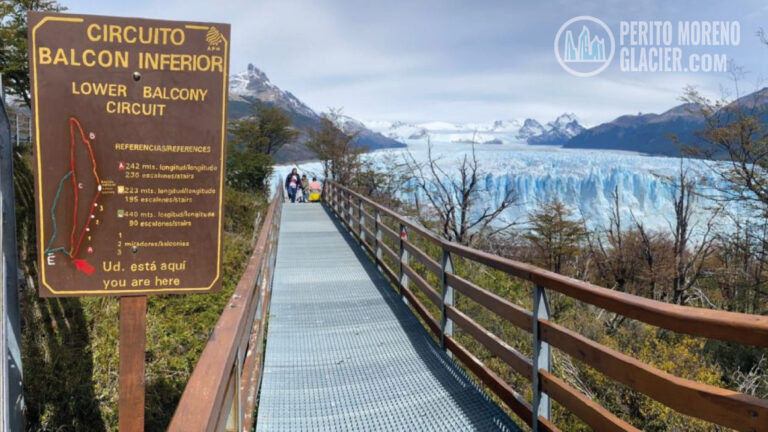
Complete Tour to Perito Moreno Glacier: Boat Navigation & Lunch
Enjoy a Perito Moreno Glacier tour from el Calafate in a full day, with lunch and boat navigation included
How Do Icebergs Form in Lago Argentino?
Iceberg formation begins long before the ice reaches the lake.
Snow Accumulates in the Andes
At high elevations, repeated snowfall accumulates faster than it completely melts. Over time, the weight of new snow compresses the lower layers.
Fresh snow contains a considerable amount of air. As compression continues, individual snow crystals become denser and gradually transform into firn—a granular intermediate stage between snow and glacier ice.
After years of additional pressure, the firn becomes dense glacial ice.
Gravity Moves the Glacier Downhill
A glacier is not a motionless block. It flows slowly under its own weight.
The ice deforms internally and may also slide over the underlying rock. Its speed is affected by:
- Glacier thickness
- Slope
- Bedrock shape
- Meltwater beneath the glacier
- Friction
- Temperature
- The depth of the water at its terminus
As the glacier travels through valleys and across uneven terrain, the ice is subjected to tension and compression.
El Calafate, Perito Moreno & Estancia Cristina – 4 Nights
A wonderful 4-night program to visit Perito Moreno Glacier from El Calafate and visit the Estancia Cristina in the national park!
Crevasses and Fractures Develop
The surface of a glacier cannot bend smoothly around every change in terrain. Stress creates cracks known as crevasses.
Some crevasses remain shallow, while others deepen or connect with existing fractures. When several stress fractures merge close to the glacier front, a piece of ice may eventually separate.
The U.S. Geological Survey explains that icebergs are calved when glacier stress fractures combine and a section of ice breaks away.
The Glacier Reaches the Lake
Several glaciers inside Los Glaciares National Park terminate directly in water. These are commonly described as lake-terminating glaciers.
Water can contribute to melting and destabilization along the submerged portion of the glacier front. At the same time, the glacier continues pushing ice toward the lake.
Eventually, a fractured piece separates. It may:
- Fall from the exposed glacier wall
- Slide into the lake
- Break away beneath the water
- Rise suddenly from below the surface
- Rotate after losing support
- Fragment into several smaller pieces
This event is known as glacier calving.
Perito Moreno Glacier & Pristine Luxury Camp – 4 Nights
A wonderful 4-night program to visit Perito Moreno Glacier from El Calafate and finalizing with a glamping experience!

Why Does Glacier Calving Sound So Powerful?
A large section of ice separating from a glacier can produce a deep crack, rumble or thunder-like sound.
Several physical processes contribute to the noise:
- Ice fractures propagate through the glacier.
- Large blocks strike the water.
- Air is displaced.
- Waves hit the shore or other ice.
- The glacier continues adjusting after the initial break.
Sound travels more slowly than light, so visitors may see the ice move before hearing the loudest part of the event.
For this reason, when you hear a sudden crack, the visible break may already have happened elsewhere along the glacier front.
Why Do Some Icebergs Rise from Below the Water?
Not every calving event begins above the lake.
Glacial ice extends below the waterline. A submerged piece can separate from the glacier and rise rapidly because ice is less dense than water.
When it reaches the surface, the iceberg may emerge dramatically, roll or momentarily stand in a vertical position. These underwater calving events can be especially unpredictable.
Visitors should never assume that an apparently calm section of water close to a glacier is safe.
How Much of an Iceberg Is Underwater?
Most of an iceberg’s total mass remains below the surface. The exact proportion depends on the density of the ice, the density of the surrounding water and the amount of rock or sediment trapped inside it.
The familiar statement that only about one-tenth is visible is a useful approximation, but real icebergs vary.
The underwater shape may also extend far beyond what is visible from a boat. This is one reason navigation routes must maintain regulated distances from glacier fronts and large floating ice.
Why Are Some Lago Argentino Icebergs Blue?
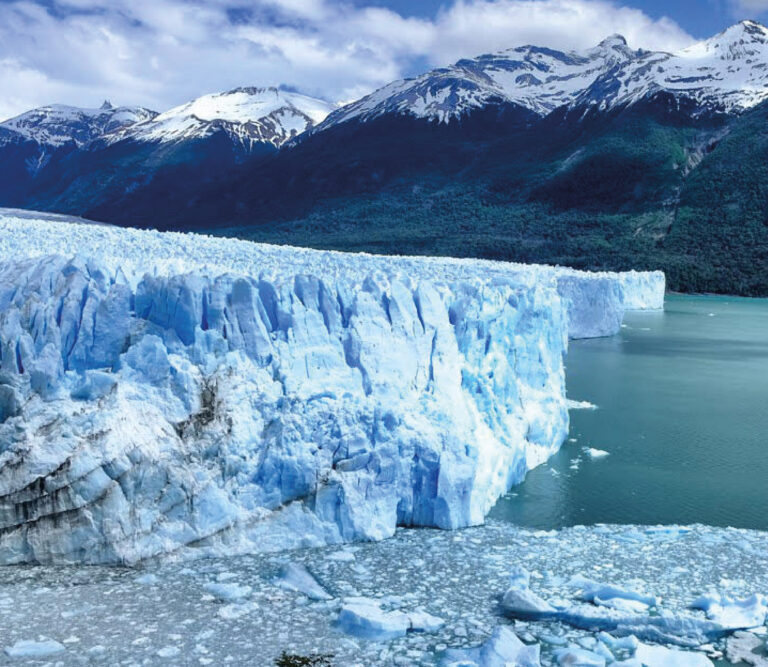
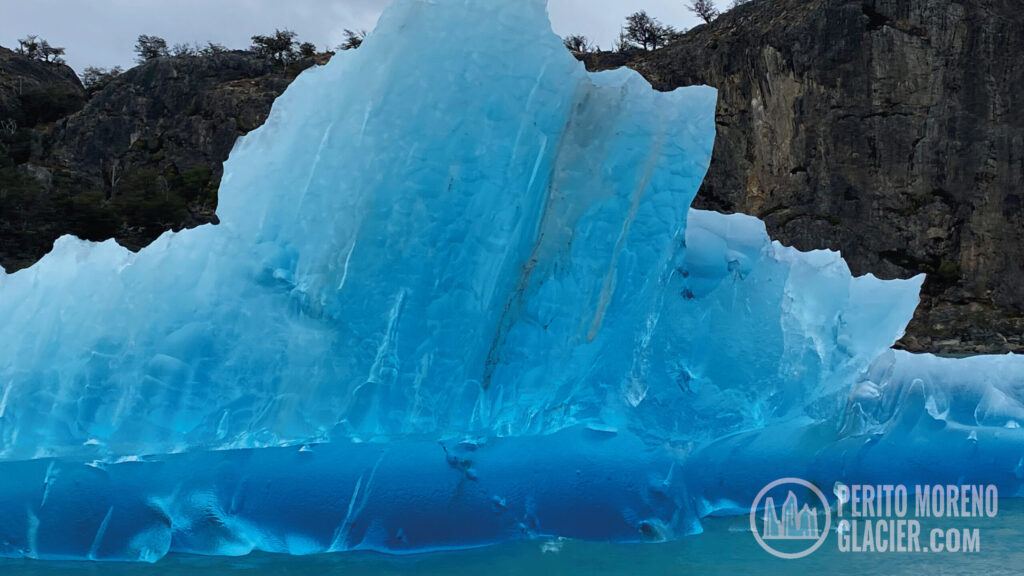
One of the most striking sights in Los Glaciares National Park is a newly calved iceberg with deep blue surfaces.
Glacier ice appears blue because ice absorbs more red wavelengths from white light while allowing blue wavelengths to travel farther through it. The longer the path light travels inside dense ice, the more intense the blue can appear. U.S. Geological Survey
Dense Ice Contains Fewer Air Bubbles
Young snow contains abundant air and scatters many wavelengths of light, making it look white.
Deep inside a glacier, centuries of pressure compress the ice and reduce the size and number of visible air spaces. This denser ice can display a stronger blue color.
Freshly Exposed Ice Can Look More Intense
A newly fractured surface may reveal dense internal ice that was previously protected from weathering.
After exposure to air, sunlight, rain and melting, the surface becomes rougher and increasingly filled with tiny cracks. These changes scatter more light and may make the iceberg appear whiter.
Color Depends on the Weather
The same iceberg can look different within minutes.
Its apparent color is influenced by:
- Direct sunlight
- Cloud cover
- Viewing angle
- Surface water
- Background color
- Distance from the observer
- Camera exposure
- Whether the surface is fresh or weathered
Overcast conditions can sometimes reveal subtle blue tones more effectively than strong midday sunlight.

Why Do Some Icebergs Have Black or Brown Stripes?
Dark lines inside Patagonian icebergs are usually bands of sediment, dust or rock debris incorporated into the glacier.
As a glacier moves, it can:
- Scrape material from the valley floor
- Receive debris from rockfalls
- Fold sediment into layers
- Transport volcanic dust
- Concentrate debris along fractures
When a section calves, these layers become visible in the iceberg.
Dark bands do not necessarily mean that the ice is dirty or polluted. They can be part of the geological history recorded during the glacier’s movement.
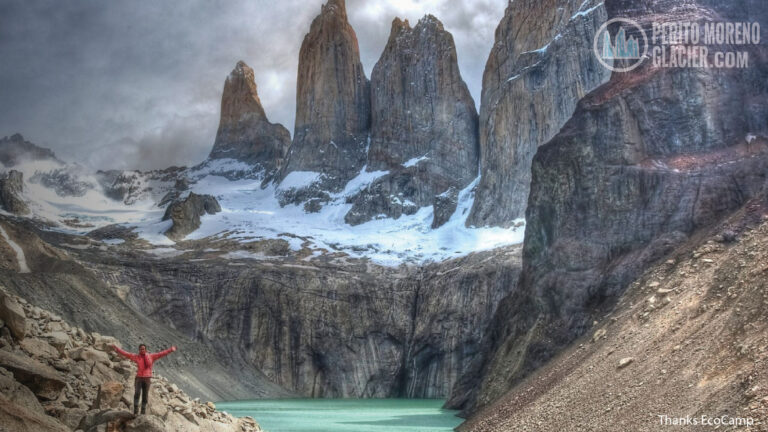
Amazing Patagonia: Ushuaia, El Calafate & Torres del Paine National Park
Book this amazing tour including Ushuaia, El Calafate, and the unique Torres del Paine National Park
Why Are the Waters of Lago Argentino Turquoise?
The lake’s characteristic color is linked to extremely fine particles of rock produced by glacial erosion.
As glaciers move across bedrock, they grind it into a fine powder often called glacial flour or rock flour. Meltwater carries this suspended sediment into the lake.
The particles interact with sunlight, contributing to Lago Argentino’s milky turquoise, blue-green or gray appearance.
Color varies according to:
- Sediment concentration
- Wind
- Cloud cover
- Water depth
- Sunlight
- Location within the lake
- Proximity to glacial inflow
The contrast between turquoise water and blue-white icebergs is especially visible from elevated viewpoints and navigation vessels.
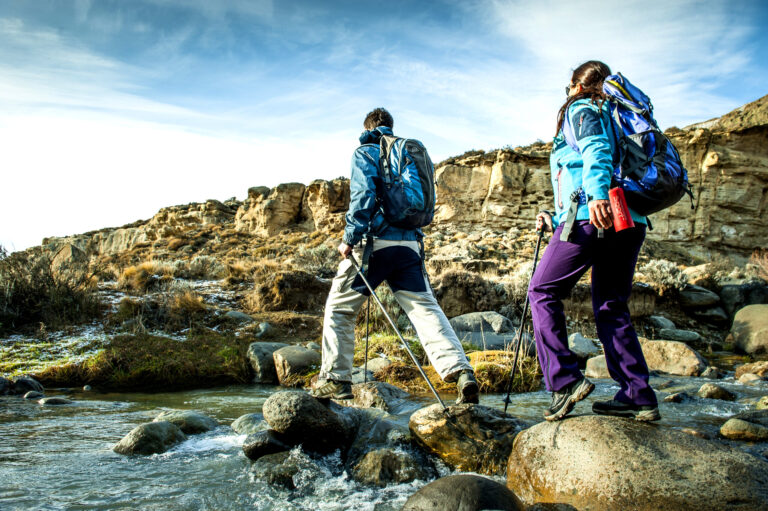
Cañadon Experience: Trekking & Stay
Discover Patagonia's hidden canyons on a 7 km trek with marine fossils, wildlife sightings, and a local meal at 800 meters.
Which Glaciers Produce Icebergs in Lago Argentino?
Several glaciers flow toward different arms of Lago Argentino.
Perito Moreno Glacier
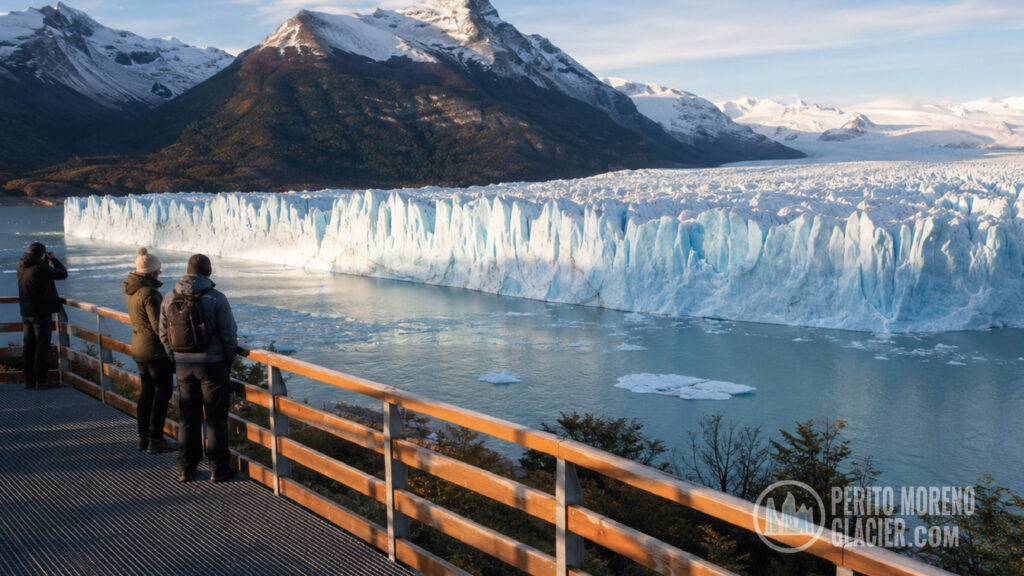
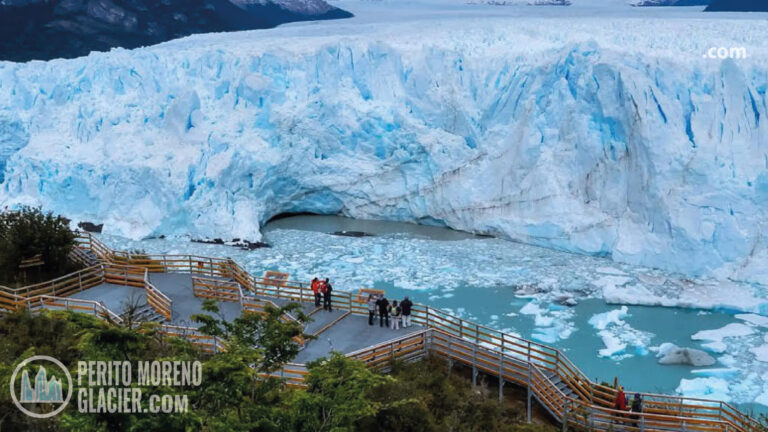
Perito Moreno is the most accessible glacier and the easiest place to observe individual calving events from land.
Its front reaches the waters near the Canal de los Témpanos and Brazo Rico. The glacier is particularly famous because its movement can periodically block the passage of water between Brazo Rico and the main body of Lago Argentino, creating the conditions for a dramatic rupture.
Argentina’s National Parks Administration describes this process as the consequence of the advancing glacier reaching the Magallanes Peninsula and interrupting water circulation between Brazo Rico and the main lake.
Icebergs produced by Perito Moreno are often visible:
- Directly in front of the glacier
- In the Canal de los Témpanos
- Along the southern face
- From the main viewing platforms
- During authorized boat excursions
Upsala Glacier
Upsala Glacier occupies a remote sector of the northern arms of Lago Argentino.
The glacier and its surrounding channels can produce some of the lake’s most impressive concentrations of floating ice. Visitors may encounter large icebergs some distance from the glacier front because wind and water currents move them through the lake’s channels.
The front of Upsala and navigation routes may change according to ice conditions. A high concentration of icebergs can restrict how closely vessels approach.
This is not a failure of the excursion. It is part of the dynamic glacial environment.
Spegazzini Glacier
Spegazzini Glacier is another major attraction reached through the northern branches of Lago Argentino.
Icebergs may be observed during the navigation toward the glacier and in nearby channels. The scenery combines floating ice, steep mountain walls, forest and the glacier’s high front.
The number and size of visible icebergs vary daily.
Other Glaciers
Los Glaciares National Park contains many additional glaciers, including Seco and Onelli in the broader southern park area, as well as numerous glaciers outside the immediate Lago Argentino navigation system.
Not every glacier produces large, easily visible icebergs. The amount of floating ice depends on how the glacier terminates, its movement and its interaction with the lake.
Where Can Visitors See Icebergs in Lago Argentino?
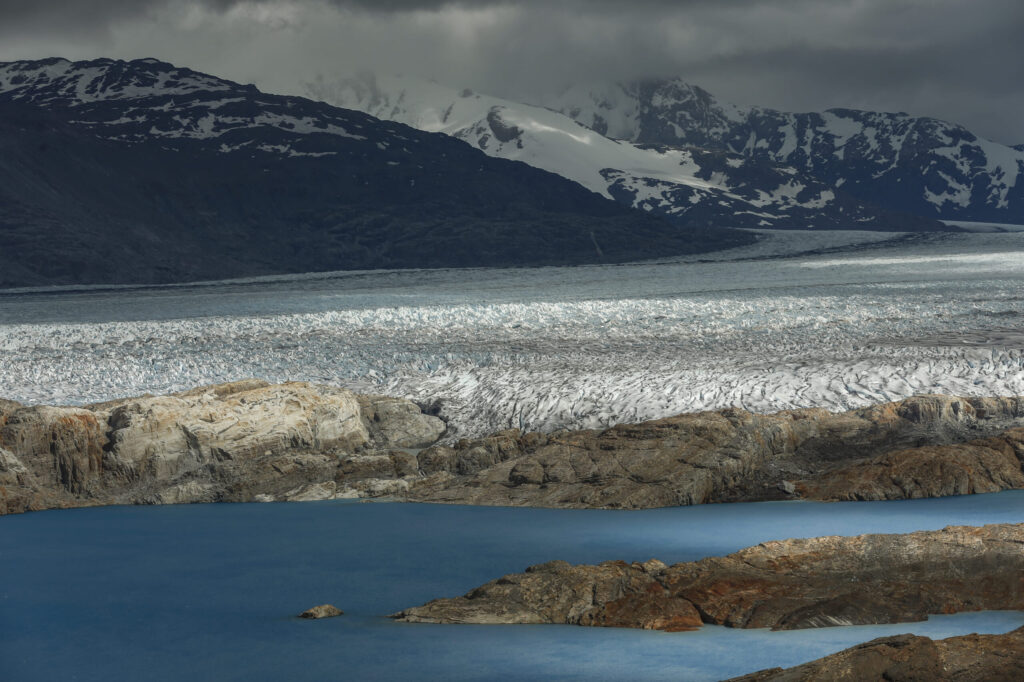
There is no single permanent “iceberg field.” Icebergs move, melt and fragment, so sightings depend on recent calving activity, wind and lake conditions.
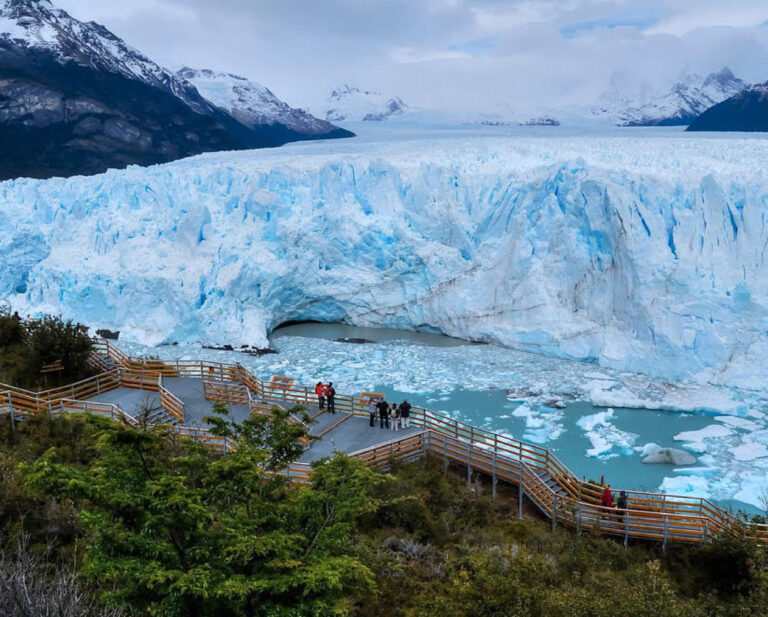
Perito Moreno Glacier Walkways
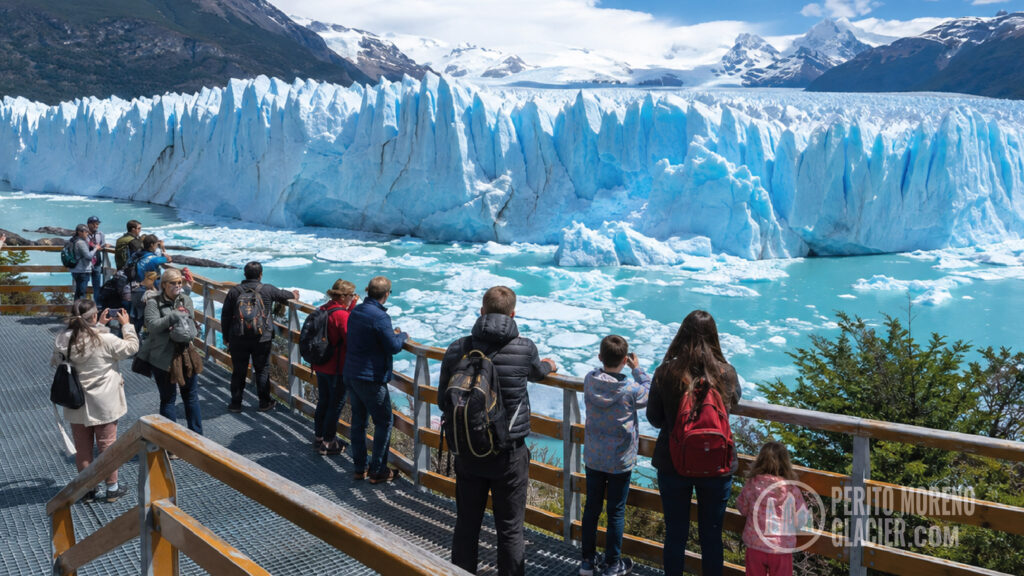
The walkways are the best option for seeing glacier calving and nearby ice without boarding a boat.
From different viewpoints, visitors may observe:
- Freshly calved blocks
- Ice fragments beneath the glacier wall
- Larger pieces drifting away
- Waves created by falling ice
- Icebergs rotating or splitting
- Blue ice surfaces exposed after calving
The elevated walkways also help visitors understand the scale of the glacier and its relationship with the surrounding lake.
However, the number of icebergs visible from the platforms can vary. A calm period may produce relatively little floating ice, while recent calving can fill sections of the water with fragments.
Cañadon Experience: Trekking & Stay
Discover Patagonia's hidden canyons on a 7 km trek with marine fossils, wildlife sightings, and a local meal at 800 meters.
Canal de los Témpanos
The name can be translated as “Iceberg Channel.”
Located beside the Perito Moreno sector, it is one of the most logical places to look for ice discharged from the glacier. Some blocks remain near the glacier, while others drift through the channel.
The channel can be observed from parts of the walkway system and explored from the water through authorized excursions.
Boat Trip Along Perito Moreno’s Southern Face
Short navigations departing from the Perito Moreno area provide a lower, water-level perspective.
These excursions may offer views of:
- Floating ice near the glacier
- The scale of the ice wall
- Fresh fracture lines
- Ice caves and textures
- Small waves caused by calving
The National Parks Administration lists navigation options departing from the walkway sector, including excursions toward the glacier’s southern face.
Boat captains determine the safe approach according to current conditions.
Upsala Channel and the Northern Arms of the Lake
Longer navigations from El Calafate travel through branches of Lago Argentino toward the Upsala and Spegazzini sectors.
The Upsala Channel is often among the most productive areas for observing large free-floating icebergs. Some can be significantly larger than those normally seen close to Perito Moreno.
Depending on conditions, boats may navigate among widely dispersed pieces or encounter dense concentrations that prevent further approach.
Spegazzini Channel
The route toward Spegazzini Glacier may also contain floating ice from surrounding glaciers.
Here, icebergs appear within a dramatic mountain corridor. It is an excellent sector for photographing the relationship between ice, water, forest and rock.
Punta Bandera Navigation Routes
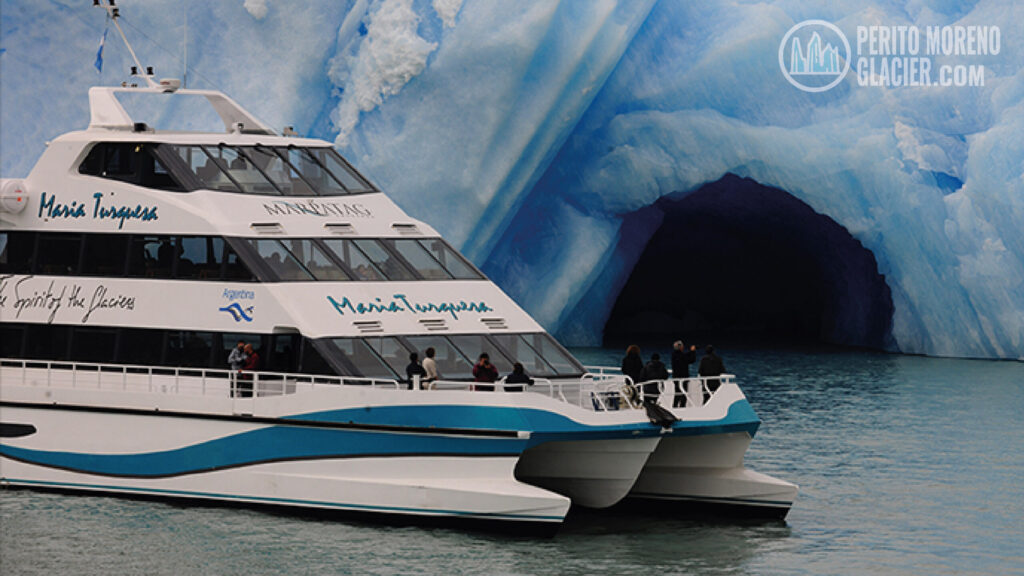
Many full-day lake excursions depart from Punta Bandera, outside El Calafate.
Icebergs are not normally guaranteed immediately after departure. They become more likely as the vessel enters glacial channels and approaches the western sectors of the lake.
Ask the operator which channels and glaciers are included rather than selecting an excursion solely from a photograph.
Can Icebergs Be Seen from El Calafate?
El Calafate is located on the southern shore of Lago Argentino, but the town is far from the main glacier fronts.
Small pieces of ice may occasionally be transported toward more open sections of the lake. However, El Calafate’s waterfront should not be promoted as a dependable iceberg-viewing location.
For a meaningful iceberg experience, visit Perito Moreno or take a navigation into the glacial arms of Lago Argentino.
What Is the Best Way to See the Largest Icebergs?
Longer lake navigations generally provide the strongest opportunity to see large, detached icebergs, particularly in channels influenced by Upsala Glacier.
Perito Moreno is usually better for observing the actual formation process because visitors can spend time facing the glacier front and may witness calving directly.
A useful distinction is:
| Experience | Best for |
|---|---|
| Perito Moreno walkways | Watching and hearing calving from land |
| Short Perito Moreno navigation | Viewing ice from water level |
| Upsala-area navigation | Potentially seeing larger free-floating icebergs |
| Spegazzini navigation | Combining icebergs with mountain and glacier scenery |
| El Calafate waterfront | Lake views, but unreliable iceberg sightings |
Is There a Best Time of Year to See Icebergs?
Iceberg sightings are possible throughout the operating season, but there is no date that guarantees more or larger icebergs.
Calving is influenced by multiple interacting factors:
- Glacier movement
- Internal fractures
- Air temperature
- Water temperature
- Water depth
- Recent weather
- Wind
- Lake currents
- Glacier-front geometry
Warmer conditions can contribute to surface melting and instability, but a single warm afternoon does not guarantee a dramatic calving event.
Visitors should be cautious about claims that calving always occurs at a particular hour.
What Happens to an Iceberg After It Calves?
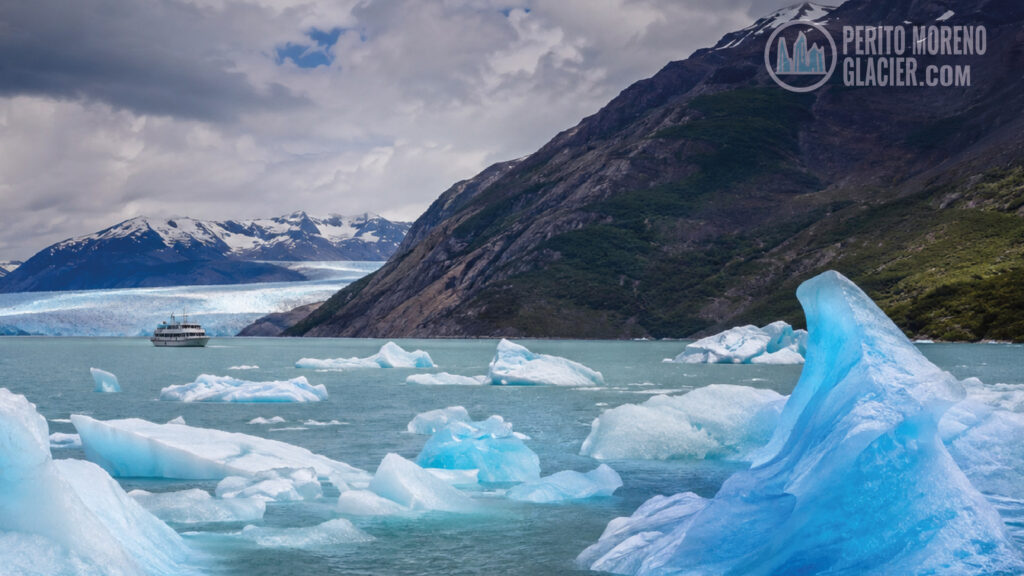
Once detached, an iceberg begins an individual and unpredictable journey.
It May Rotate
The visible shape of an iceberg is not necessarily its most stable position.
Melting changes its weight distribution. When its centre of mass shifts, the entire iceberg can roll suddenly, exposing ice that was previously underwater.
This newly exposed ice often appears exceptionally blue and polished.
It Drifts
Wind acts on the visible portion of the iceberg, while currents influence the larger submerged mass.
Because these forces may act in different directions, an iceberg does not always move in the same direction as the surface wind.
It Fractures
Internal weaknesses continue to expand after calving. Temperature changes, waves and collisions with other pieces can break the iceberg into smaller fragments.
It Melts
Air, sunlight, rain and lake water gradually reduce the iceberg.
The process can create:
- Holes
- Arches
- Overhangs
- Channels
- Transparent edges
- Sculptural shapes
These formations are temporary. An arch visible in the morning may collapse later the same day.
El Calafate Special Adventure Program: Big Ice and Horseback Riding or Trekking in Estancia Cristina
Enjoy visiting Perito Moreno Glacier, walking over the ice of the glacier and a wonderful trekking or horseback riding in a remote estancia in the national park

Are Icebergs Dangerous?
Yes, particularly at close range.
An iceberg can rotate, split or shed ice without warning. A large calving event can also create waves.
Potential hazards include:
- Sudden rolling
- Submerged extensions
- Falling fragments
- Collision
- Calving waves
- Rapidly changing navigation channels
- Extremely cold water
Visitors should never swim toward an iceberg, climb onto one or approach floating ice with an unauthorized kayak or private craft.
Use only authorized operators and follow crew instructions.
Why Do Boats Sometimes Stay Far from the Glacier?
Boat distance is determined by safety and current conditions, not by the size of a camera lens or the expectations created by promotional photographs.
Captains must consider:
- Active calving
- Floating ice
- Submerged hazards
- Waves
- Wind
- Visibility
- Navigation regulations
- Escape routes
- Changing channels through the ice
A glacier can release ice from above or below the water. Remaining farther away may be essential even when the visible lake surface appears calm.
Can You Touch or Take a Piece of Ice?
Visitors may occasionally encounter small pieces of natural ice during an authorized activity, but they should not collect ice independently inside the national park.
Natural materials belong to the protected environment.
Do not:
- Cross barriers to reach floating ice
- Remove ice, plants or rocks
- Enter restricted shorelines
- Ask boat crews to approach unsafe pieces
- Throw objects at icebergs
- Leave food or waste in the lake
Tips for Photographing Lago Argentino Icebergs
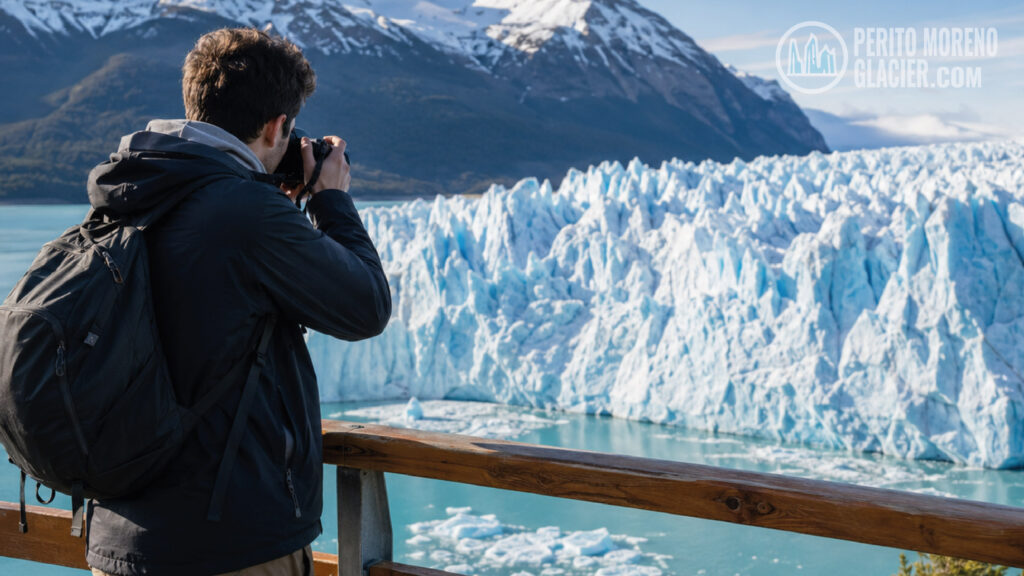
Use a Telephoto Lens for Details
A telephoto lens helps capture:
- Blue fractures
- Sediment bands
- Water droplets
- Birds resting near the ice
- Iceberg shapes
- Glacier-front textures
It also produces close-looking images while the boat remains at a safe distance.
Include a Sense of Scale
Without a recognizable reference, a large iceberg may appear small.
Possible scale references include:
- A distant vessel
- The glacier front
- Mountains
- Forest
- The lake channel
Avoid photographing other passengers in a way that compromises their privacy.
Argentinian & Chilean Patagonia: Ushuaia, El Calafate, El Chalten and Puerto Natales
Enjoy visiting Ushuaia and the end of the world... El Calafate and Perito Moreno Glacier... El Chalten and the Fitz Roy Mount and Puerto Natales and Torres del Paine National Park!
Protect the Camera from Spray
On a navigation, carry:
- Lens cloth
- Rain cover
- Secure camera strap
- Spare battery
- Waterproof bag
- Lens hood
Do not change lenses unnecessarily on an exposed deck when wind or spray is strong.
Use a Fast Shutter Speed from a Moving Boat
The boat, water and iceberg may all be moving. A faster shutter speed can reduce motion blur.
Image stabilization helps, but it cannot always compensate for abrupt vessel movement.
Watch the Ice, Not Only the Screen
Some of the most memorable moments happen between photographs: an iceberg rotating, sunlight reaching a blue surface or a distant calving event echoing through the channel.
Spend part of the experience observing without a camera.
Common Misconceptions About Lago Argentino Icebergs
“Every Iceberg Comes from Perito Moreno”
False. Perito Moreno produces many of the most accessible icebergs, but Upsala, Spegazzini and other lake-connected glaciers also release ice.
“Blue Ice Is Younger”
Generally, the opposite is true. Deep blue ice is usually dense, compressed glacier ice with fewer visible air spaces.
“A Quiet Glacier Is Inactive”
False. Glaciers continue moving and deforming even when no calving is visible.
“The Rupture of Perito Moreno and Normal Calving Are the Same”
They are related to glacier dynamics but are not identical.
Normal calving occurs when sections detach from the glacier front. The famous rupture cycle involves the glacier blocking the water passage near the Magallanes Peninsula, pressure building in Brazo Rico and the eventual failure of the ice barrier.
“Large Icebergs Are Safe Because They Move Slowly”
False. Large pieces can rotate or fracture suddenly, and much of their structure remains hidden underwater.
“Boat Tours Guarantee a Calving Event”
No operator can guarantee calving. It is a natural and unpredictable process.
Both Sides of Southern Patagonia: El Calafate & Puerto Natales
Wonderful 6-night program to combine El Calafate and Perito Moreno Glacier with Puerto Natales and Torres del Paine National Park
Frequently Asked Questions
Are there real icebergs in Lago Argentino?
Yes. Lago Argentino contains freshwater icebergs produced when lake-terminating glaciers calve.
Where is the easiest place to see them?
The Perito Moreno walkways and nearby boat excursions provide the easiest access. Longer Upsala and Spegazzini navigations may reveal larger or more numerous free-floating icebergs.
Can you see icebergs without taking a boat?
Yes. Floating ice and calving can often be observed from the Perito Moreno Glacier walkways.
Where can you see the biggest icebergs?
The channels influenced by Upsala Glacier often offer opportunities to see especially large icebergs, although conditions change constantly.
Why are some icebergs bright blue?
Dense glacier ice absorbs more red light while transmitting and scattering blue wavelengths. Freshly fractured or recently rotated ice may show the strongest blue color.
Are Lago Argentino’s icebergs salty?
No. They are formed from compacted snowfall and float in a freshwater lake.
How long does an iceberg last?
There is no fixed lifespan. Size, shape, weather, water temperature, wind and exposure all influence how quickly it melts or fragments.
Is calving caused only by warm weather?
No. Temperature can influence melting, but glacier movement, stress, fractures, water depth and the shape of the glacier front also contribute.
Can icebergs block a navigation route?
Yes. Floating ice may force vessels to change course, remain farther from a glacier or cancel part of an approach.
Is it safe to kayak near an iceberg?
Only authorized activities operating under park regulations should be considered. Icebergs can roll, break and generate waves without warning.
How to Plan an Iceberg-Focused Visit
For the most complete experience, combine two perspectives:
Day One: Perito Moreno Glacier
Spend several hours on the walkways to understand how glacier movement produces icebergs. Add a short navigation if you want to see the ice from lake level.
Day Two: Lago Argentino Navigation
Choose an excursion toward the northern glacial arms, confirming whether the current route includes the Upsala and Spegazzini sectors.
This combination provides:
- Direct observation of a glacier front
- The possibility of hearing calving
- Elevated panoramic views
- Water-level photography
- Larger free-floating ice
- A clearer understanding of Lago Argentino’s scale
Because routes and access depend on weather, ice and park regulations, reserve through an operator that clearly explains what is included and how the itinerary changes when navigation conditions are unfavorable.
Final Thoughts
The icebergs of Lago Argentino are not static monuments. They are temporary pieces of a constantly moving glacial system.
They begin as snowfall in the Andes, become compressed into glacier ice, travel slowly toward the lake and finally separate through calving. Afterward, they drift, rotate, fracture and melt—sometimes over days, sometimes over a much longer period.
Perito Moreno offers the most accessible opportunity to watch this process begin. The Upsala and Spegazzini channels reveal what happens after the ice moves into the wider lake.
Seeing both environments transforms the iceberg from a beautiful photographic subject into evidence of an active and continually evolving Patagonian landscape.
Both Sides of Southern Patagonia: El Calafate & Puerto Natales
Wonderful 6-night program to combine El Calafate and Perito Moreno Glacier with Puerto Natales and Torres del Paine National Park
El Calafate, El Chaltén & Torres del Paine – 7 Nights
Enjoy visiting El Calafate and Perito Moreno Glacier... El Chalten and the Fitz Roy Mount and Torres del Paine National Park!