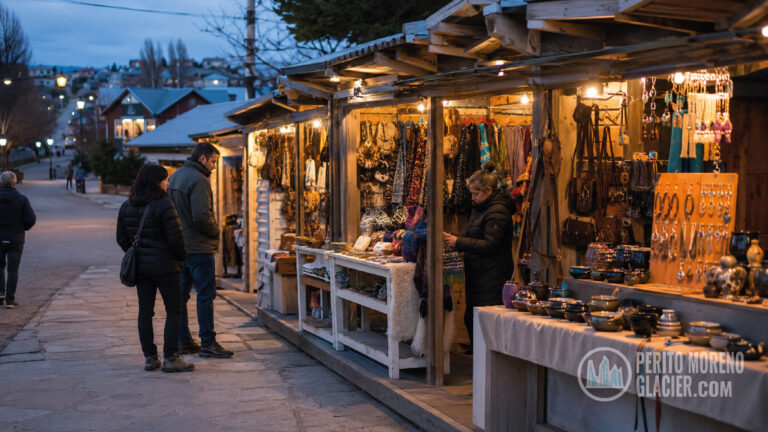
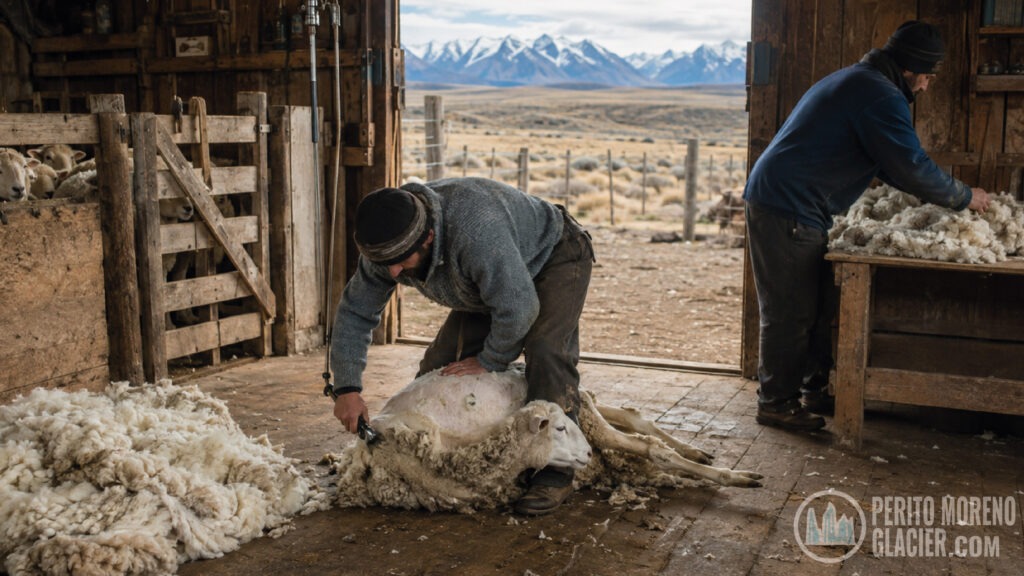
Patagonian wool begins far from the shelves of El Calafate. It starts on exposed steppe, where sheep, pasture, water, weather and skilled labor have to be managed across large distances. The fleece is shorn, classed, pressed, tested and sold through a chain that most travelers never see. Some of it eventually becomes yarn or clothing; some leaves the region as raw or processed fiber.
Understanding that chain changes the way you look at a wool sweater or woven scarf. “Patagonian” can describe a landscape, a style, a place of manufacture or the true origin of the fiber—and those are not the same claim. This guide explains how sheep ranching shaped the estancia economy around El Calafate, what a visitor may see at a working ranch and how to make a more responsible purchase without confusing a tourism label with traceability.
Wool in Patagonia: An Economic History, Not an Ancient Tradition
Southern Patagonia was inhabited long before sheep ranching. Aónikenk or Tsoneka communities knew and moved through this territory before European settlement and the creation of the large livestock estates. It would therefore be inaccurate to present the commercial wool economy as an ancient Indigenous tradition.
Large-scale sheep production expanded in southern Patagonia during the late nineteenth and early twentieth centuries. Ranches occupied extensive areas of steppe, and settlements developed as supply, transport and administrative points. El Calafate’s early history is connected to that rural world even though tourism and Los Glaciares National Park now dominate the visitor’s image of the town.
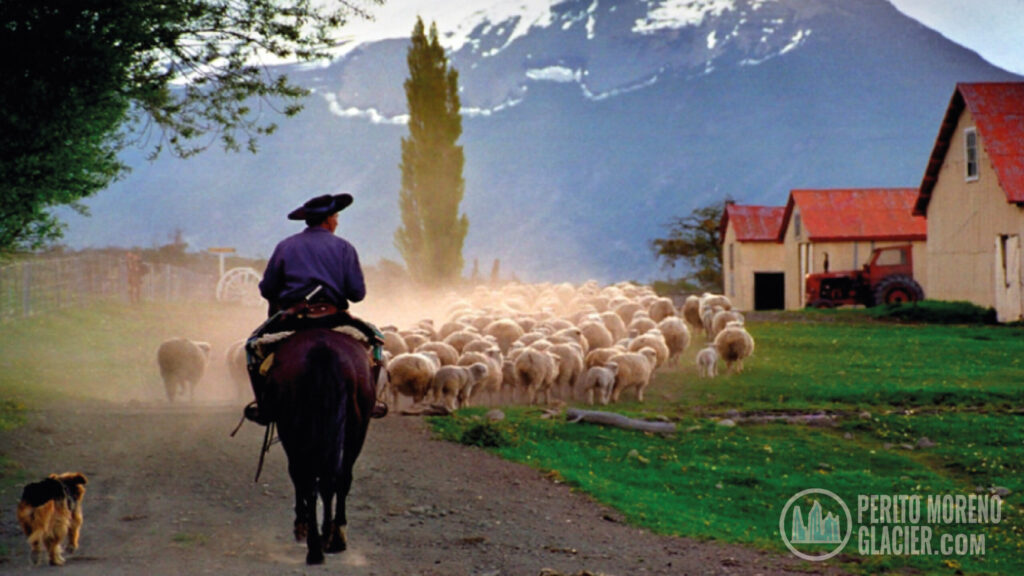
The scale of an estancia can be difficult to understand from a downtown shop. Sparse vegetation, variable rainfall, cold and wind mean that animals require much more land than they would in a lush pasture. A large property is not automatically a highly productive one; its capacity depends on forage, water, season and management.
In more than 25 years of arranging travel in Patagonia, I have noticed that visitors often expect the estancia to be a preserved stage set. The most interesting visits are precisely the opposite. They show a business that has had to adapt—combining livestock, tourism and other income while keeping people and animals working in a demanding environment.

Big Ice Trekking on Perito Moreno Glacier From El Calafate
Join our Big Ice Trekking Tour on Perito Moreno Glacier. Explore ice formations & rugged beauty. Book now for an unforgettable experience.
How the Estancia Wool Economy Works
Flock, Pasture and the Annual Cycle
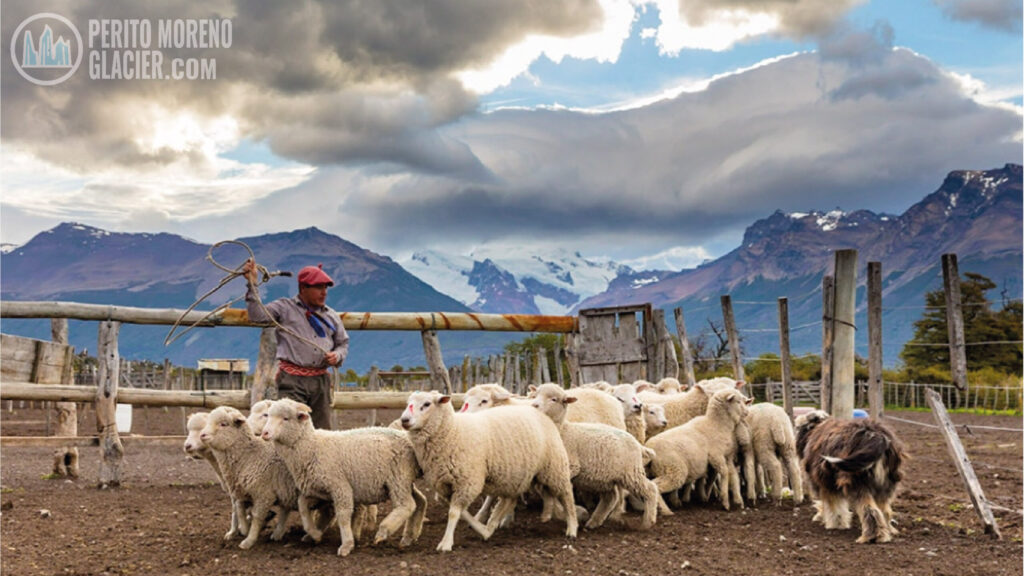
Wool production begins with flock and land management. Ranch staff monitor grazing areas, water, animal condition, reproduction and weather. Decisions about when and where sheep graze affect both the animals and the long-term condition of the steppe.
The work is seasonal but continuous. Lambing, animal-health tasks, moving flocks, maintaining fences and water points, preparing the shearing shed and managing winter risk all form part of the same system. Shearing is the most visible moment, not the whole economy.
Shearing Is Skilled Teamwork
Argentina’s official agricultural information describes mobile shearing crews—comparsas de esquila—whose members travel between properties during the season. The work is physical and specialized. A crew can include shearers, people who gather and throw fleeces onto the classing table, wool classers, press operators, cooks and other support roles.
A trained shearer aims to remove the fleece efficiently while handling the animal correctly and avoiding unnecessary second cuts that reduce fiber quality. Once removed, the fleece is not simply dropped into an anonymous bag. It can be skirted, separated by category, classed and pressed into labeled bales.
Programs such as PROLANA provide protocols for shearing, preparation, classing, packaging and animal welfare. A logo or program name should still be checked rather than assumed, but the existence of a standard matters: good wool is the result of documented work, not only a romantic ranch image.
Testing Determines More Than Color
Wool value is influenced by measurable characteristics. Argentine wool laboratories analyze factors such as fiber diameter or fineness, staple length, tensile strength, clean yield and vegetable matter. Breed, nutrition, weather, handling and contamination can all affect the final lot.
A traveler does not need to memorize laboratory terms before buying a scarf. The lesson is simpler: soft appearance and natural color do not reveal origin or quality by themselves. Producers and processors make decisions from specifications that are invisible on a finished garment unless the seller communicates them.
Sale, Processing and Export
After classing and baling, wool can pass through brokers, buyers, washing or combing plants, spinners, dyers and manufacturers. Those steps may occur in different provinces or countries. Consequently, an item can be knitted in Patagonia from imported yarn, or made elsewhere using fiber that genuinely came from Patagonian sheep.
Neither product is automatically deceptive. The problem begins when broad language encourages the buyer to assume a complete local chain that the label cannot support.
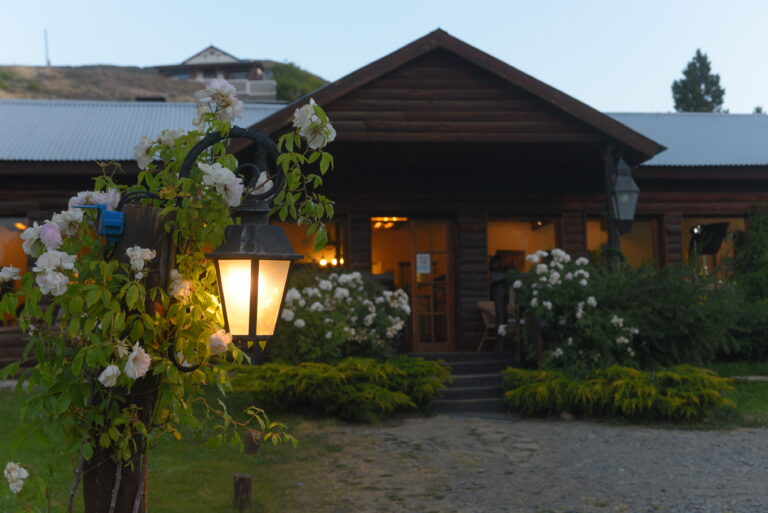
Estancia 25 de Mayo in El Calafate
Enjoy a visit to this beautiful estancia in the Argentinean Patagonia: Estancia 25 de Mayo. An amazing Patagonia ranch!
Why Estancias Diversified Beyond Wool
Livestock income is exposed to weather, forage conditions, animal losses, transport costs and international commodity prices. Many Patagonian properties have therefore combined traditional production with meat, accommodation, meals, guided rides, hiking or day visits.
Tourism does not necessarily replace ranching. At a working estancia, it can provide complementary income, maintain buildings, support employment and give visitors access to a landscape that is otherwise difficult to understand. It can also simplify the story too much if a brief demonstration is presented as the entire annual operation.
When I recommend an estancia visit, I tell travelers to watch the details around the demonstration: the design of the shearing shed, the classing table, the old press, the separation of fleeces and the way staff explain seasonal work. Those details reveal more than a staged photograph with a sheep.
El Calafate, Perito Moreno & Estancia Cristina – 4 Nights
A wonderful 4-night program to visit Perito Moreno Glacier from El Calafate and visit the Estancia Cristina in the national park!
What Visitors Can Learn Near El Calafate
Estancia Nibepo Aike
The El Calafate tourism office describes Nibepo Aike as an active livestock property that also receives visitors. Depending on the program and season, the experience may include rural tasks, sheep-related demonstrations, historic buildings, walking or riding and a meal.
Our separate guide to Estancia Nibepo Aike and Patagonian ranch life explains the property experience in detail. This wool article uses the estancia only as a practical example of how production, heritage and tourism can coexist.

Estancia Nibepo Aike Tour from El Calafate
Experience rural Patagonia through hands-on traditions and local cuisine.
El Galpón del Glaciar
The municipal tourism office presents El Galpón del Glaciar around a historic shearing barn dating from 1912. Its interpretation includes the shearing process, worker roles, wool quality and the way the product enters a market. That makes the barn useful for travelers interested in the economic chain rather than only in ranch scenery.
Activities can change with season, animal needs, weather and the program purchased. Confirm the current itinerary before booking. A sheep-shearing demonstration is not guaranteed every day of the year, and responsible animal management should take priority over a visitor timetable.
The Environmental Reality Behind a Renewable Fiber
Wool is a renewable animal fiber, but “renewable” is not the same as “sustainable.” Its impact depends on how sheep, pasture, water, soil, wildlife, labor and the later processing chain are managed.
Historical overgrazing contributed to land degradation in parts of Patagonia. Today, drought and forage scarcity remain serious operational challenges in Santa Cruz. The responsible response is not to declare every ranch harmful or every wool product ecological. It is to ask what evidence supports a claim.
Questions That Matter at the Ranch Level
- Is stocking adjusted to the actual carrying capacity of the pasture?
- Are vegetation and soil condition monitored over time?
- How are water points and sensitive areas managed?
- What animal-welfare protocol is followed during handling and shearing?
- Is wildlife considered in fencing and land-management decisions?
- Can the property explain where its wool goes after the bale leaves?
A visitor may not receive a complete technical report, but a precise answer is more credible than a vague statement that everything is “natural.” Patagonia’s open landscape can look untouched from a vehicle while still carrying a long history of use.
Processing Also Matters
Traceability should not stop at the ranch gate. Washing, spinning, dyeing, finishing, transport, durability and end-of-life all influence a product’s footprint. Undyed wool is not automatically low-impact, and a brightly dyed piece is not automatically irresponsible; the relevant question is what process and standard were used.
The most sustainable garment is often one that is well made, genuinely used for years, repaired when necessary and cared for correctly. Buying less—and buying with enough information to keep the item—matters more than collecting labels.
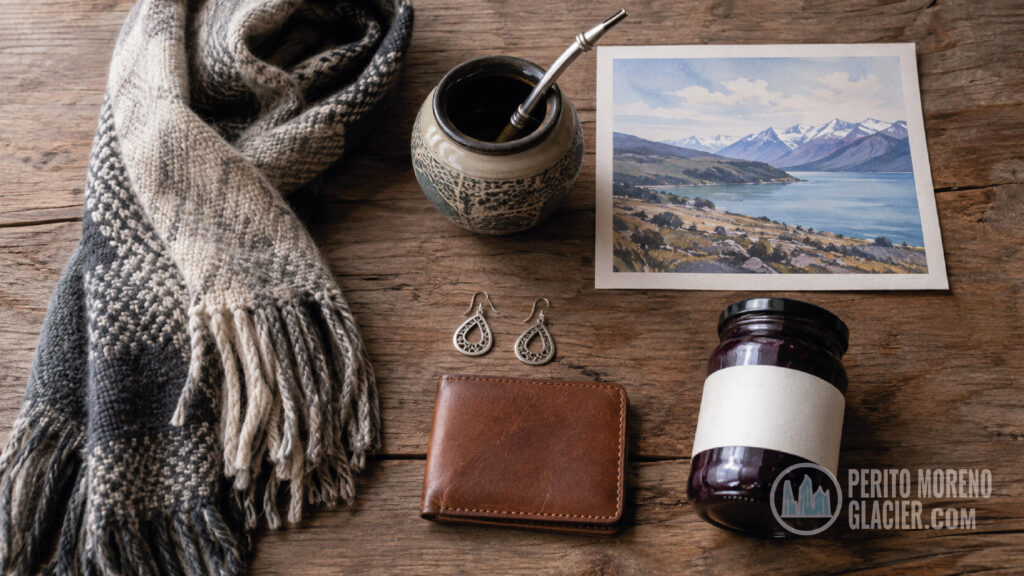
How to Buy Patagonian Wool Responsibly in El Calafate
1. Read the Fiber Composition
Look for the percentage of wool and any other fibers. “Wool blend” may include acrylic, polyester, nylon, cotton or another animal fiber. A blend can be useful for durability or price, but it should not be sold as pure wool.
If the product has no composition label, ask. For a substantial purchase, a verbal “it is all natural” is not enough.
2. Separate Three Origin Questions
Ask these individually:
- Where was the wool fiber produced?
- Where was the yarn spun or dyed?
- Where was the final item made?
“Made in Patagonia” may answer only the third question. “Patagonian style” may answer none of them. A transparent seller should be able to say what is known and what is not.
Complete Tour to Perito Moreno Glacier: Boat Navigation & Lunch
Enjoy a Perito Moreno Glacier tour from el Calafate in a full day, with lunch and boat navigation included
3. Identify the Maker or Producer
A maker’s name, workshop, cooperative, ranch or business address gives you something verifiable. Hand-knitted does not necessarily mean the wool is local, and factory-made does not necessarily mean it is low quality. What matters is whether the claim matches the documented chain.
4. Ask About Animal Welfare and Land Management
For fiber described as traceable or responsible, ask which farm, standard or protocol supports that description. PROLANA participation, a recognized certification or documented producer information is more meaningful than an unqualified green label.
Do not expect every small artisan to control the whole upstream chain. An honest admission that the yarn origin is unknown is better than an invented story.
5. Check Construction and Care
Inspect seams, edges, closures, snagging and consistency. Ask how the item should be washed, dried and stored. Wool commonly benefits from gentle washing, limited agitation and flat drying, but follow the specific care label because blends and finishes differ.
Also consider whether the seller offers repairs or can explain how to mend the piece. Durability is part of responsible purchasing.
6. Keep the Label and Receipt
The label helps with care and substantiates composition and origin. A receipt is useful for a higher-value item and can help if customs officers ask what you bought.
For entry into the United States, a clean, commercially finished wool garment is different from a raw fleece, hide or untreated animal product. Agricultural and wildlife rules vary by material and condition. Keep purchases clean and labeled, declare animal-origin goods when required, and check current U.S. rules before traveling with raw or minimally processed material.
Perito Moreno Glacier & Pristine Luxury Camp – 4 Nights
A wonderful 4-night program to visit Perito Moreno Glacier from El Calafate and finalizing with a glamping experience!
Common Claims—and What They Actually Prove
“Handmade in Patagonia”
This can indicate local labor and design. It does not prove that the sheep, wool, spinning or dyeing were local.
“100% Wool”
This describes fiber composition if the label is accurate. It does not identify geographic origin, labor conditions, land management or the manufacturing process.
“Natural”
Wool is a natural animal fiber, but processing may include detergents, dyes, treatments and long-distance transport. The word alone is not an environmental standard.
“Artisanal”
It may refer to scale or method, but it does not replace the maker’s identity, composition and origin information. Ask what part of the process was performed by the artisan.
“Patagonian Wool”
This is the strongest geographic implication and deserves the clearest evidence. Ask whether it refers to fleece origin or simply to the place or style of the finished product.
Frequently Asked Questions
Why Did Sheep Ranching Become Important in Patagonia?
The region’s open steppe supported extensive livestock systems, and wool became a tradable product that could be compressed and transported over long distances. The industry influenced rural settlement, infrastructure, employment and the growth of service towns.
Can I See Sheep Shearing Near El Calafate?
Some estancia programs include a shearing demonstration or interpretation of the shearing shed. Availability depends on season, property and animal management, so confirm the exact current program rather than assuming it is included.
Is All Wool Sold in El Calafate Local?
No. A product sold or knitted in El Calafate may use fiber or yarn from elsewhere. Read the label and ask separately about fiber, yarn and manufacturing origin.
Is Patagonian Wool Ethical?
Geography alone cannot answer that. Look for information about animal welfare, shearing standards, land condition, labor, traceability, processing and durability.
What Is the Best Wool Item to Buy?
The best item is one whose composition and origin you understand, whose construction suits its purpose and whose care you can manage. A smaller, frequently used item can be a more responsible purchase than an expensive garment bought only for the Patagonia name.
A Better Story to Take Home
A responsible wool purchase should connect you to real work, not to a simplified frontier fantasy. The sheep, the pasture, the moving shearing crews, the classer, the laboratory, the spinner and the maker all contribute to the final object. If a seller can explain only the last step, treat the rest of the story as unknown.
If you want to understand that economy before buying, include a working-estancia experience in your El Calafate itinerary. PeritoMorenoGlacier.com can help match the visit to your schedule and interests, while the questions in this guide will help you look beyond the demonstration and recognize what responsible production actually requires.
Argentinian & Chilean Patagonia: Ushuaia, El Calafate, El Chalten and Puerto Natales
Enjoy visiting Ushuaia and the end of the world... El Calafate and Perito Moreno Glacier... El Chalten and the Fitz Roy Mount and Puerto Natales and Torres del Paine National Park!
El Calafate Special Adventure Program: Big Ice and Horseback Riding or Trekking in Estancia Cristina
Enjoy visiting Perito Moreno Glacier, walking over the ice of the glacier and a wonderful trekking or horseback riding in a remote estancia in the national park

El Chaltén Tour Package: 1–3 Nights
Enjoy visiting El Chaltén, a place to discover the Fitz Roy Massif, and wonderful adventure activities