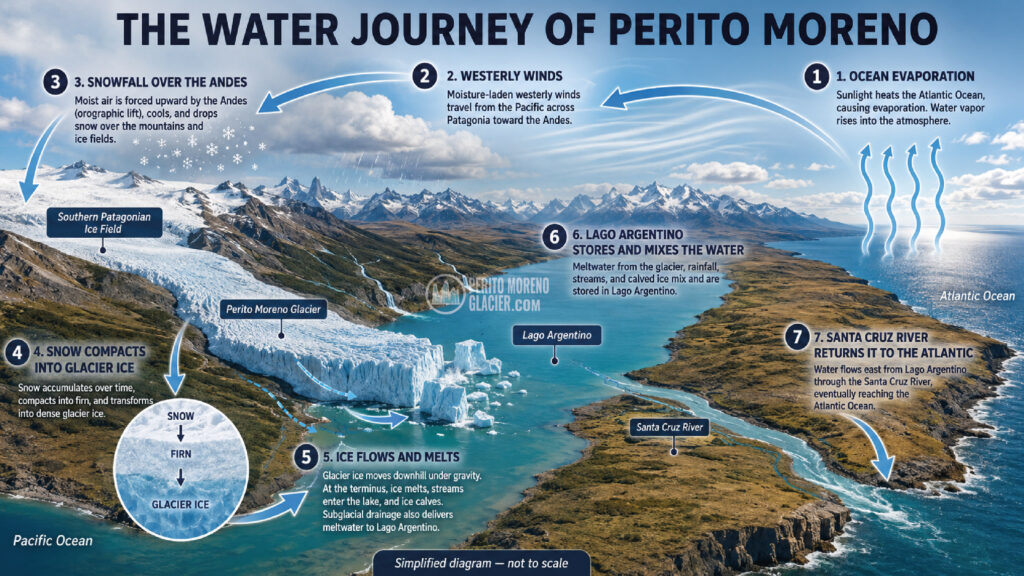
Water does not simply “come from the glacier” at Perito Moreno. It travels through an interconnected system that begins in the atmosphere, crosses the Southern Andes as snow and rain, may remain stored as ice for years or much longer, enters Lago Argentino through several pathways and eventually flows across Patagonia through the Santa Cruz River to the Atlantic Ocean.
Understanding this journey changes the way you see the landscape. The wind becomes part of the story. The white surface behind the glacier is no longer just scenery but an accumulation zone. The milky turquoise lake reveals suspended rock particles. Even an iceberg becomes a moving reservoir of freshwater already floating inside the lake that received it.
This guide follows that journey step by step while separating three processes that are often confused: the water cycle, the glacier’s mass balance, and the famous ice-dam rupture at Brazo Rico.
The Perito Moreno water cycle in one minute
The complete journey can be summarized in seven stages:
- Solar energy drives evaporation from the oceans and other water surfaces.
- Patagonia’s prevailing westerly winds transport moisture mainly from the Pacific toward the Andes.
- Air rises over the mountains, cools and releases rain or snow through orographic precipitation.
- Snow that survives summer accumulates and gradually compacts into firn and glacier ice.
- Gravity moves the ice downslope through Perito Moreno Glacier toward Lago Argentino.
- Surface melt, rain, tributary streams, subglacial drainage and calving transfer water to the lake.
- Lago Argentino drains eastward through the Santa Cruz River, which reaches the Atlantic Ocean.
Water also returns directly to the atmosphere through evaporation and sublimation throughout the system. The cycle therefore has no single starting point; the oceans-to-clouds sequence is simply the clearest place to begin explaining it.
Stage 1: moisture approaches Patagonia from the Pacific
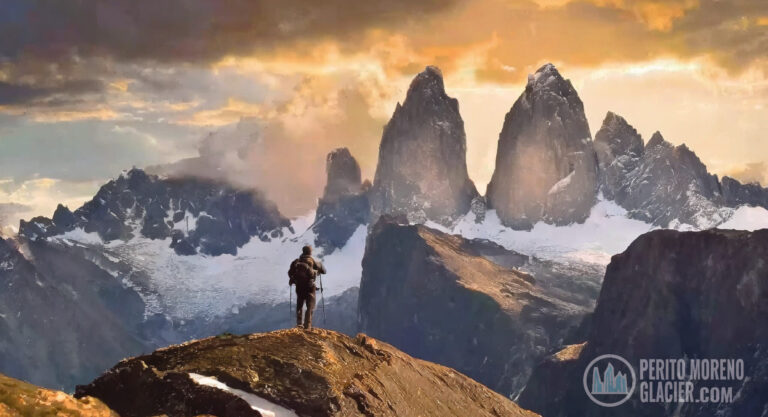
The Southern Andes stand directly in the path of the powerful mid-latitude westerlies. These winds circle the Southern Hemisphere and carry humid air eastward from the Pacific Ocean toward Patagonia.
Ocean evaporation is powered primarily by solar energy. Invisible water vapor rises into the atmosphere and becomes part of moving air masses. Moisture can be recycled through many atmospheric pathways, and the global cycle includes both the Pacific and Atlantic oceans. For the Southern Patagonian Ice Field, however, the Pacific and the prevailing winds from the west are the main immediate combination.
This helps explain one of Patagonia’s sharpest environmental contrasts. The western Andean slopes and icefield receive enormous amounts of precipitation, while the Argentine steppe to the east is much drier. The mountains extract much of the moisture before the air crosses the range.
Argentinian & Chilean Patagonia: Ushuaia, El Calafate, El Chalten and Puerto Natales
Enjoy visiting Ushuaia and the end of the world... El Calafate and Perito Moreno Glacier... El Chalten and the Fitz Roy Mount and Puerto Natales and Torres del Paine National Park!
Stage 2: the Andes turn moving air into snowfall
When moist air encounters the Andes, it is forced upward. Rising air expands and cools. As it cools, water vapor condenses into cloud droplets or freezes into ice crystals, eventually falling as precipitation. This terrain-driven process is called orographic precipitation.
At lower elevations and during milder conditions, precipitation may fall as rain. Higher in the mountains and across the icefield, much of it arrives as snow. Strong winds redistribute that snow, stripping exposed ridges and depositing it in sheltered basins. What matters to the glacier is not simply how much snow falls, but how much remains after melting, sublimation and wind transport.
The difference between snowfall and surviving snow is crucial. A spectacular winter does not automatically guarantee a positive year for the glacier if the following summer is unusually warm or prolonged.
Argentinian & Chilean Patagonia: Ushuaia, El Calafate, El Chalten and Puerto Natales
Enjoy visiting Ushuaia and the end of the world... El Calafate and Perito Moreno Glacier... El Chalten and the Fitz Roy Mount and Puerto Natales and Torres del Paine National Park!
Stage 3: snow becomes firn and glacier ice
Fresh snow contains a great deal of air. As new layers accumulate, the older snow beneath them is compressed. Individual snow crystals change shape and become denser, producing an intermediate material known as firn. With continued pressure and recrystallization, air spaces shrink and firn turns into glacier ice.
This transformation does not happen instantly. Water can therefore remain stored in the upper glacier system in several forms:
- seasonal snow;
- multi-year firn;
- dense glacier ice;
- liquid water within pores, cracks and drainage channels.
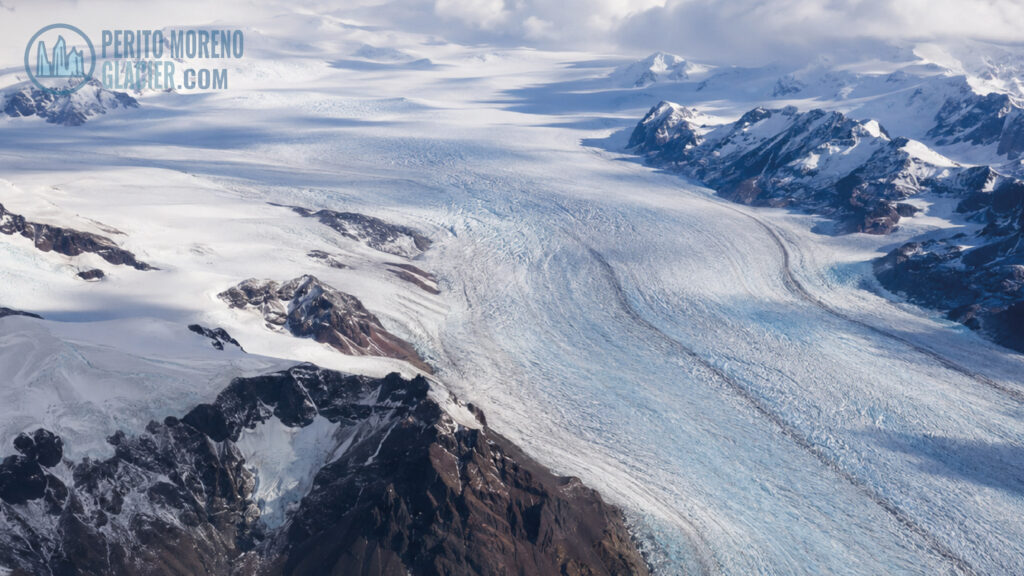
The high part of the glacier where annual accumulation tends to exceed annual losses is called the accumulation zone. Its lower boundary changes from year to year according to snowfall and summer conditions.
Stage 4: frozen water begins to flow
A glacier is not a stationary block. Ice deforms under its own weight and moves downslope under gravity. Where liquid water is present at the bed, basal sliding can also contribute to motion. Perito Moreno is a temperate, lake-terminating glacier: parts of its ice are at or near the pressure-melting point, allowing a complex internal and subglacial drainage system.
The glacier transports stored water from the high accumulation zone toward lower, warmer elevations. Flow speed is not the same everywhere. Central ice generally moves differently from ice near valley walls, and motion near the front responds to bed shape, lake depth, friction, ice thickness and stresses produced by calving.
This distinction prevents a common misunderstanding: a glacier can move forward even while losing mass. Ice velocity, front position and mass balance describe different things. A flowing conveyor belt may continue carrying ice toward the lake while the total amount of ice entering the system becomes smaller than the amount leaving it.
Big Ice & Estancia Cristina Adventure – 3 Nights
Enjoy visiting Perito Moreno Glacier, walking over the ice of the glacier and a wonderful trekking or horseback riding in a remote estancia in the national park

Stage 5: how water leaves Perito Moreno Glacier
Water reaches Lago Argentino from Perito Moreno Glacier in more than one form.
Surface melting
Sunlight, warm air, rain and turbulent heat exchange melt snow and exposed ice. Meltwater gathers in tiny channels, streams and pools before entering crevasses or flowing toward the glacier margins.
Internal and subglacial drainage
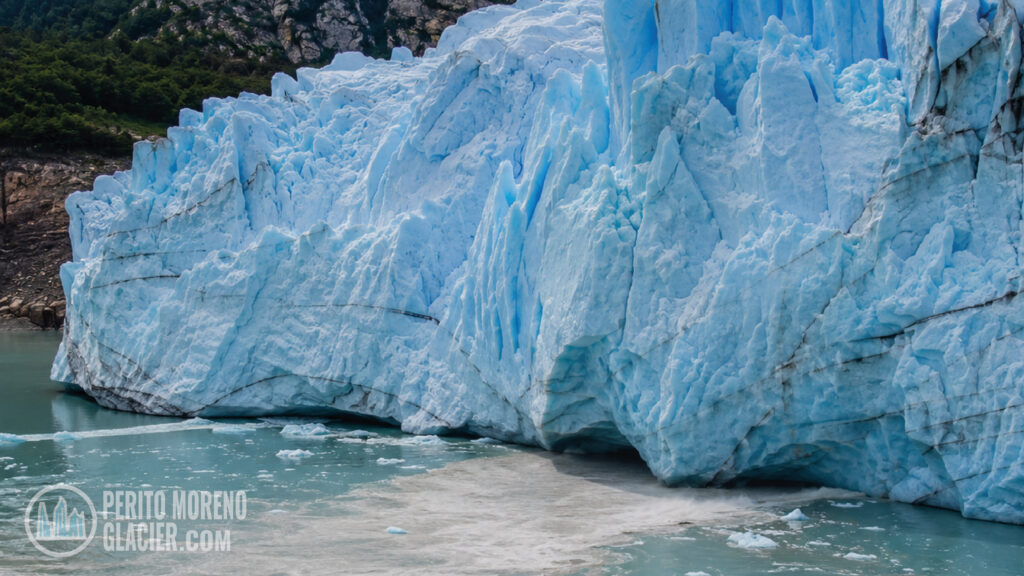
Water can descend through fractures and moulins, travel within the glacier and move along its bed. Some of it emerges near the terminus as sediment-rich discharge. Because subglacial water interacts with crushed rock beneath the glacier, it can carry extremely fine mineral particles into the lake.
Ice calving
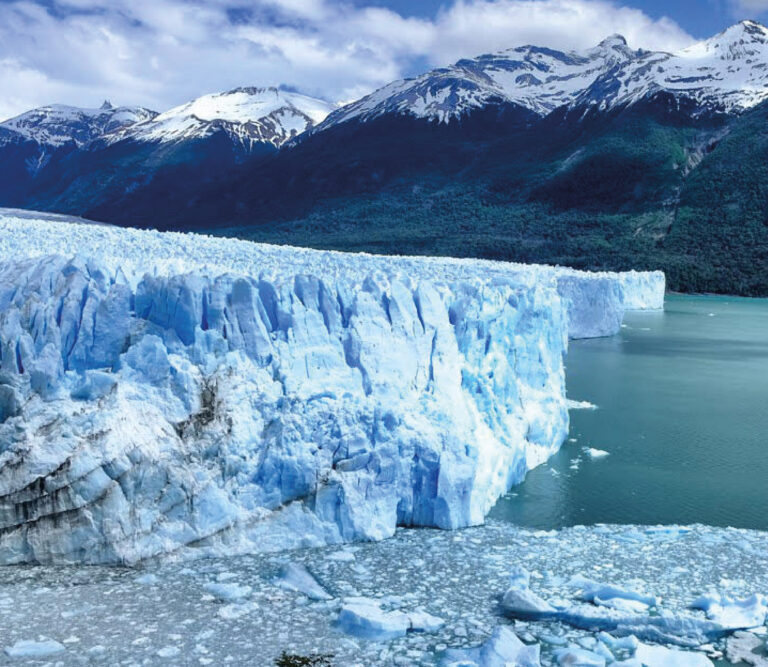
Blocks separating from the glacier front transfer frozen freshwater directly to Lago Argentino. Once floating, an iceberg displaces an amount of lake water equivalent to its own mass. Consequently, its later melting does not significantly raise the lake in the simple way that adding land-based meltwater does; it is already afloat.
Rainfall and marginal streams
Rain falling on the glacier, nearby mountains, moraines and forested slopes can run directly into the lake or enter the glacier’s drainage network. Perito Moreno is important, but it is only one contributor within the much larger Lago Argentino watershed.
Stage 6: Lago Argentino becomes a vast mixing and storage basin
Lago Argentino is Argentina’s largest lake and one of the defining features of Los Glaciares National Park. It receives water and ice not only from Perito Moreno but also from a network of rivers, streams and glaciers spread across several arms and channels.
The lake performs three important hydrological roles.
It stores water
Water does not pass immediately from the glacier to the ocean. Lago Argentino temporarily stores and redistributes inflow, moderating rapid variations before releasing water through its outlet.
It mixes water from different sources
Rain, snowmelt, glacier melt, subglacial discharge and tributary rivers enter with different temperatures, densities and sediment loads. Wind, currents, seasonal heating and cooling, and inflow patterns mix them unevenly across the deep lake basin.
It transports glacial flour
The celebrated turquoise or milky color comes largely from glacial flour: microscopic mineral particles produced as moving ice grinds bedrock. These particles remain suspended because they are extremely small. They scatter sunlight, making the water appear blue-green, turquoise or grey depending on concentration, depth, cloud cover and viewing angle.
The color is not proof that the water is chemically contaminated, nor is it created by blue dye or melted ice alone. It is an optical effect involving light and suspended sediment.
For a broader description of the lake’s arms, dimensions and visitor activities, link to Lago Argentino: Perito Moreno Glacier Area rather than repeating those topics here.
5-day W Trekking with EcoCamp in Torres del Paine
The famous W Trekking in Torres del Paine, in a 5-day program with base in EcoCamp!

Stage 7: from Lago Argentino to the Atlantic Ocean
Lago Argentino releases water through the Santa Cruz River. The river flows east across the Patagonian steppe and eventually reaches the Atlantic Ocean. In this sense, snow that once fell in the high Andes can cross Santa Cruz Province in three radically different states: compressed glacier ice, lake water and flowing river water.
Discharge varies through time. Snowmelt, glacier melt, rain, lake storage and climatic patterns all influence the volume and timing of river flow. The lake buffers part of this variability, which means the river is not a simple real-time gauge of what Perito Moreno Glacier did on a particular day.
Research treating Perito Moreno Glacier, Lago Argentino and the Santa Cruz River as a single hydrological system has found that the relationships among climate, melt-season discharge and ice-dam events are complex. No individual river fluctuation should be attributed automatically to one calving event or one warm afternoon at the glacier.
Where Brazo Rico enters the water-cycle story
Brazo Rico is the southern arm beside the Perito Moreno terminus. Under open conditions, it communicates with the wider Lago Argentino system through the sector beside Península de Magallanes and Canal de los Témpanos.
When the glacier front reaches the peninsula and seals the connection, it can temporarily block the normal drainage of Brazo Rico and Brazo Sur. Water arriving in those arms continues to accumulate, creating a level difference across the ice barrier. Eventually, water may enlarge a subglacial passage, reopen the connection and produce the celebrated ice arch and rupture sequence.
This is a temporary reorganization of flow inside the lake system, not the entire water cycle. The atmospheric supply, snowfall, glacier flow, lake storage and river drainage continue whether or not a rupture occurs.
To keep the site architecture clear, use the new article Brazo Rico and Canal de los Témpanos Explained for geographic orientation, and send readers to The Rupture of Perito Moreno Glacier: All You Need to Know for the full dam-and-collapse sequence.
Water cycle, glacier mass balance and front position: three different ideas
These terms are related but not interchangeable.
| Concept | What it describes | Main inputs and controls |
|---|---|---|
| Water cycle | Movement and storage of water through atmosphere, snow, ice, lake and river | Evaporation, precipitation, freezing, melting, runoff and discharge |
| Glacier mass balance | Whether the glacier gains or loses total ice over a defined period | Snow accumulation versus surface melt, calving and other losses |
| Front position | Where the visible glacier terminus lies | Ice flow, calving, lake depth, bed geometry and mass supply |
A negative mass balance does not mean the glacier vanishes immediately. A retreating front does not mean all glacier motion has stopped. Similarly, an active water cycle does not tell us whether the glacier gained or lost ice during that year.
Argentinian & Chilean Patagonia: Ushuaia, El Calafate, El Chalten and Puerto Natales
Enjoy visiting Ushuaia and the end of the world... El Calafate and Perito Moreno Glacier... El Chalten and the Fitz Roy Mount and Puerto Natales and Torres del Paine National Park!
Does every drop follow the same route?
No. The seven-stage sequence is an educational model.
Some snow sublimates directly into vapor without melting. Some meltwater refreezes within snow or ice. Some rainfall returns quickly to the atmosphere through evaporation or plant transpiration. Water can be stored for different lengths of time in seasonal snow, glacier ice, groundwater, wetlands and Lago Argentino. Atmospheric moisture can also be recycled and transported far beyond the immediate basin.
The phrase “a drop of water trapped in the glacier” is therefore a useful image, not a traceable itinerary. The system is a network of pathways and reservoirs rather than a single pipe.
How climate change can alter the cycle
Climate affects both sides of the glacier’s water budget. Changes in precipitation determine how much snow is available for accumulation; temperature, radiation, wind and rainfall influence how much snow and ice are lost. Lake conditions and the geometry of the glacier bed also affect calving and frontal stability.
Recent peer-reviewed research published in 2025 reported a major change in Perito Moreno Glacier after its long period of relative stability, including accelerated thinning and retreat near the terminus. That finding makes careful terminology especially important: older descriptions of Perito Moreno as permanently “stable” should no longer be repeated without a date and qualification.
In the short term, increased melting can add runoff. Over longer periods, continued glacier shrinkage reduces the stored ice available to sustain future meltwater. The relationship is nonlinear and cannot be summarized as “warmer weather always means more river water.”
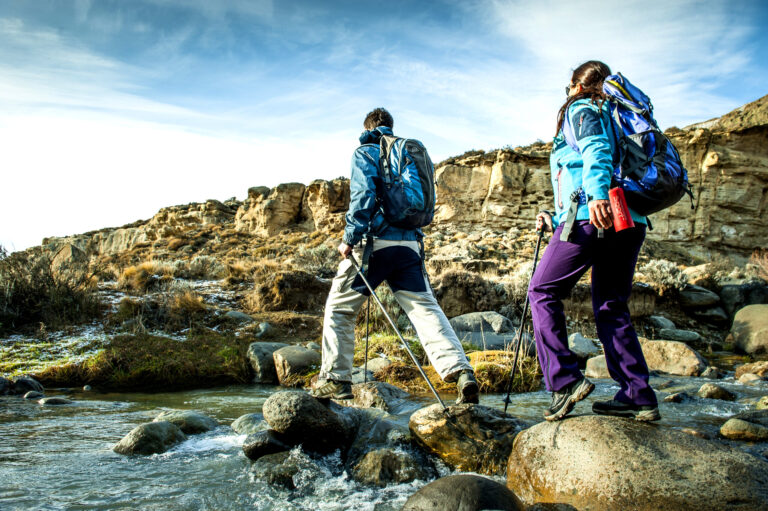
Cañadon Experience: Trekking & Stay
Discover Patagonia's hidden canyons on a 7 km trek with marine fossils, wildlife sightings, and a local meal at 800 meters.
What visitors can observe
Much of the cycle is visible during an ordinary visit if you know where to look.
From the road and walkways
Clouds arriving over the Andes reveal the atmospheric stage. Snow-covered upper surfaces indicate accumulation, while darker or wetter ice at lower elevations belongs to the ablation zone. Streams, marginal waterfalls and sediment plumes may be visible depending on season and conditions.
From a boat
The lake-level perspective makes calving, floating ice, water color and the meeting of ice and lake especially clear. Boats keep an authorized distance because calving can generate waves and unstable ice.
At Lago Argentino near El Calafate
The wide lake shows what happens after water leaves the glacier. Changes in color, wind-driven waves, shallow bays and the outlet system belong to the same watershed, even when the glacier itself is out of sight.
Visitors should treat every observation as a snapshot. A sunny afternoon, a visible meltwater stream or a large calving event cannot by itself demonstrate a long-term climatic trend.

El Chalten Trekking to Laguna Capri from El Calafate
Enjoy a wonderful trekking tour in El Chalten, located in Santa Cruz, Argentina. Amazing trekking activity in the beautiful Patagonia.
Frequently asked questions
Is all the water in Lago Argentino melted glacier ice?
No. The lake receives glacier melt and calved ice, but also snowmelt, rainfall, streams and rivers from a large watershed containing several glaciers and mountain basins.
Why is Lago Argentino turquoise?
Fine mineral sediment known as glacial flour remains suspended in the water and scatters light. Its apparent color changes with sediment concentration, depth, weather and sunlight.
Does melting an iceberg raise Lago Argentino?
A floating iceberg already displaces water according to its mass. Its melting therefore has little direct effect on lake level. Ice melting while still grounded on land or the glacier bed adds water that was not previously floating in the lake.
Is calving the same as melting?
No. Melting changes ice into liquid water. Calving mechanically detaches a block of ice from the glacier front. The calved ice usually melts later while floating in the lake.
Is the rupture part of the water cycle?
It is a hydrological event within the larger cycle. It temporarily stores water in Brazo Rico and later releases it toward the main Lago Argentino basin, but it is not the origin or endpoint of the system.
Does Perito Moreno Glacier supply the Santa Cruz River directly?
Indirectly. Water and ice from Perito Moreno enter Lago Argentino, mix with many other inflows and are later discharged through the Santa Cruz River.
How long does water remain inside the glacier?
There is no single residence time. Surface meltwater may pass through quickly, while water stored as deeper glacier ice can remain frozen for decades or longer before reaching the terminus.
One connected Patagonian system
Perito Moreno Glacier is best understood not as an isolated wall of ice but as a moving reservoir inside a much larger watershed. Pacific moisture, Andean snowfall, glacier flow, meltwater, calving, Lago Argentino and the Santa Cruz River form successive chapters of the same story.
The next time you stand before the glacier, look beyond the front. The clouds above it, the snow behind it, the sediment in the lake and the river crossing the steppe are all expressions of water changing state, changing speed and changing landscape on its journey across Patagonia.
Recommended internal links
- Lago Argentino: Perito Moreno Glacier Area
- The Rupture of Perito Moreno Glacier: All You Need to Know
- Weather in El Calafate and Perito Moreno Glacier Area
- Brazo Rico and Canal de los Témpanos Explained
- Southern Patagonian Ice Field: A Traveler’s Introduction
El Calafate Special Adventure Program: Big Ice and Horseback Riding or Trekking in Estancia Cristina
Enjoy visiting Perito Moreno Glacier, walking over the ice of the glacier and a wonderful trekking or horseback riding in a remote estancia in the national park
Enjoy the “O” Trekking Circuit in Torres del Paine National Park – 7 Nights
The most complete trekking program in Torres del Paine. A week to enjoy this amazing place in Patagonia!