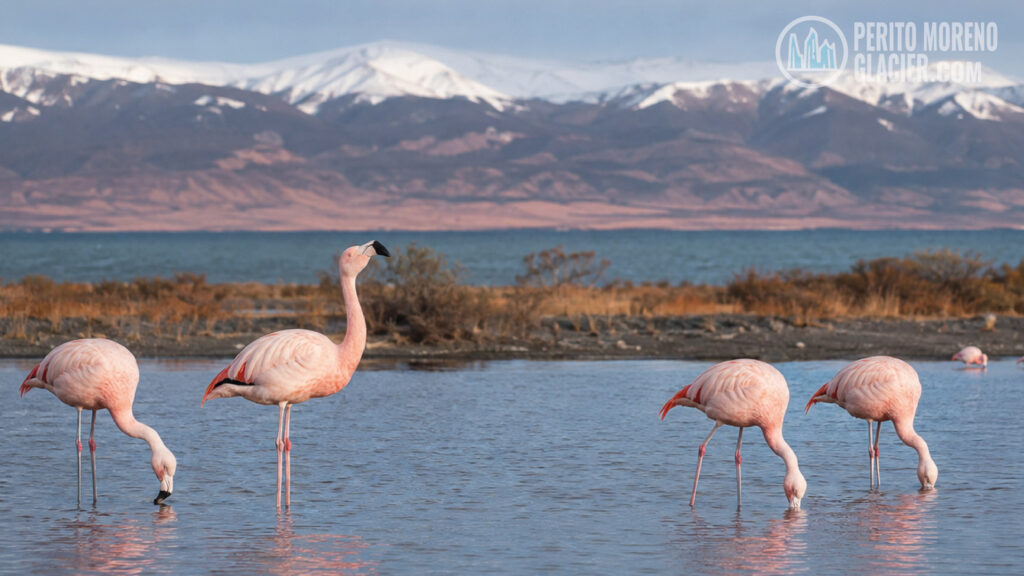
Only a short distance from downtown El Calafate, flamingos feed in shallow water while the Andes rise beyond Lago Argentino. This surprising scene belongs to Laguna Nimez Nature Reserve, one of the easiest wildlife experiences to add to a stay in Argentina’s glacier country.
The reserve is not a zoo and its flamingos are not captive. They are wild Chilean flamingos whose presence, number and location change with water levels, food availability, season and weather. That uncertainty is precisely what makes the visit worthwhile: Laguna Nimez offers an opportunity to observe real wetland behavior in a protected urban environment rather than a guaranteed close-up display.
This complete guide focuses specifically on finding, watching and photographing flamingos at Laguna Nimez. For a broader checklist covering swans, ducks, raptors and Patagonian songbirds, see Birds of El Calafate & Perito Moreno Glacier.
What Is Laguna Nimez?
Laguna Nimez is a municipal nature reserve on the southern shore of Lago Argentino, approximately one kilometer—or about ten blocks—from El Calafate’s commercial center. Its protected mosaic includes two principal lagoons, Nimez and Escondida, together with marshes, reed beds, grassland, Patagonian steppe vegetation and lake shoreline.
These connected habitats form part of the Calafateño Wetland. The combination of shallow water, vegetation, mud, open grassland and the immense nearby lake attracts aquatic birds, shorebirds, grassland species and birds of prey. Around 80 bird species have been recorded in the area, although no visitor should expect to see all of them during one walk.
Laguna Nimez is also recognized as an Important Bird Area, known locally by the Spanish acronym AICA. Its value goes beyond tourism: it protects habitat, supports research and environmental education, and demonstrates how a functioning wetland can survive beside a growing Patagonian town.
El Calafate Tour Package: 1–3 Nights
Enjoy visiting Perito Moreno Glacier and other amazing attractions in the area. Choose between our 1-2-3 night packages and discover Patagonia
Which Flamingos Live at Laguna Nimez?
The species normally seen at Laguna Nimez is the Chilean flamingo (Phoenicopterus chilensis). Despite its common name, it is not limited to Chile. Its range includes suitable wetlands in several South American countries, including Argentina.
How to Recognize a Chilean Flamingo
Adults are pale pink rather than uniformly bright pink. Their plumage may appear nearly white in flat light and warmer pink in sunshine. The wings contain deeper pink and black flight feathers, which become most visible when the bird stretches or flies.
Useful identification features include:
- A pale pink or whitish body
- A pinkish neck and head
- A bill that is pale near the base and extensively black toward the tip
- Greyish legs with noticeably pink joints
- A long, curved neck and slow, deliberate movements in shallow water
Juveniles are greyer and browner than adults. A young flamingo may therefore look surprisingly dull beside mature birds. Its coloration develops over time and is influenced by pigments called carotenoids obtained through its diet.
Cabalgata Experience: Canyon and Horseback Riding
Ride through Patagonia’s canyons, discover gaucho history, and enjoy a countryside lunch at Estancia 25 de Mayo.
Why Are Flamingos Pink?
Flamingos consume small aquatic organisms and organic matter containing carotenoid pigments. Their digestive system processes those pigments, which are deposited in feathers and other tissues. Diet, age, health and feather condition influence the intensity of the color.
The birds do not become pink simply because the lagoon itself is pink, nor is vivid color proof of a separate species. Light and camera processing can also make photographs look much more saturated than the scene appeared to the eye.
Why Do Flamingos Use Laguna Nimez?
Flamingos are filter feeders. They lower their heads—often placing the bill upside down in the water—and use specialized structures inside the bill to separate food from water and sediment. They may shuffle their feet to disturb the bottom and expose small organisms.
Laguna Nimez provides shallow feeding zones where this behavior is possible. Water depth and salinity can vary, and those changes affect where suitable food is concentrated. Consequently, flamingos may gather close to one observation point on one visit and remain distant or move elsewhere on another.
The lagoon is part of a wider network of Patagonian wetlands. Flamingos are mobile birds rather than permanent actors assigned to a single pool. Their movements connect Laguna Nimez with other feeding and resting sites across a much larger landscape.
Argentinian & Chilean Patagonia: Ushuaia, El Calafate, El Chalten and Puerto Natales
Enjoy visiting Ushuaia and the end of the world... El Calafate and Perito Moreno Glacier... El Chalten and the Fitz Roy Mount and Puerto Natales and Torres del Paine National Park!
Are Flamingos Guaranteed at Laguna Nimez?
No wildlife sighting is guaranteed. Chilean flamingos are regularly associated with Laguna Nimez and are among its signature birds, but they may be far from the trail, temporarily absent or difficult to see because of wind, glare or water conditions.
This should be made clear in trip planning. Laguna Nimez is worth visiting as a complete wetland, not only as a location for one species. Black-necked swans, coscoroba swans, upland geese, ducks, coots, ibises, grebes, lapwings and other birds may provide excellent observation even when the flamingos are distant.
If seeing flamingos is your main objective, ask reserve staff about the day’s recent sightings before beginning the circuit. Staff information is more useful than relying on a photograph posted weeks or months earlier.
Where Is Laguna Nimez and How Do You Get There?
The reserve entrance is on El Calafate’s lakeside sector, near Avenida Costanera Presidente Néstor Carlos Kirchner. It is close enough to reach independently from many central hotels.
Walking from Downtown El Calafate
From the central commercial area, allow roughly 15–25 minutes on foot depending on your starting point and pace. The walk is straightforward, but El Calafate’s wind can make even a short distance feel longer. Carry an outer layer rather than judging conditions from a sheltered hotel entrance.
By Taxi or Remis
A taxi or remis is useful for travelers with limited time or mobility, or during cold and windy weather. Because the distance is short, arrange either a one-way trip or a pickup time rather than assuming a vehicle will always be waiting at the exit.
By Car
Travelers with a rental car can reach the reserve quickly from central El Calafate. Follow current signs and parking instructions, and never drive or park beyond authorized public areas.
For a wider explanation of local mobility options, link to the Travel Guide article about public transportation, buses, taxis and remises in El Calafate when published.
Perito Moreno Glacier & Pristine Luxury Camp – 4 Nights
A wonderful 4-night program to visit Perito Moreno Glacier from El Calafate and finalizing with a glamping experience!
Opening Hours and Admission
According to the reserve’s official information at the time of writing, Laguna Nimez is open throughout the year:
- Summer: daily from 9:30 am to 7:30 pm
- Winter: daily from 10:00 am to 6:00 pm
The reserve charges admission and publishes different rates for international visitors, Argentine residents and eligible local categories.
Confirm hours, current payment methods and last admission shortly before visiting. Seasonal labels, exceptional weather or operational decisions may affect access.
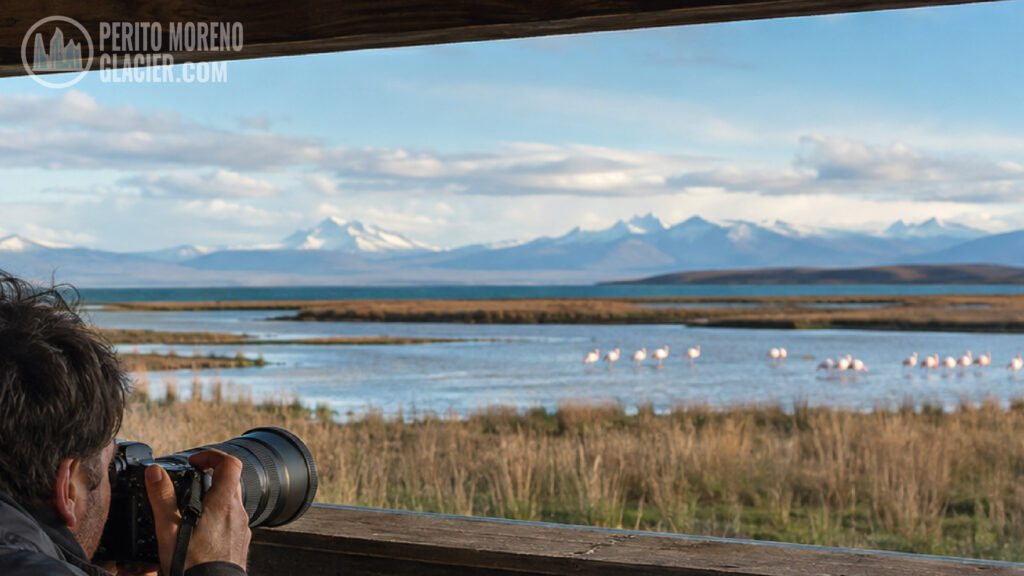
What Is the Laguna Nimez Trail Like?
The reserve has an easy, self-guided interpretive circuit of approximately 3 kilometers. It passes through the wetland’s different environments and includes signs, viewpoints and bird hides. Most visitors spend around 1½ to 3 hours, depending on wind, bird activity, photography and how often they stop.
This is not a mountain trek. The physical challenge comes mainly from exposure to wind, sun or cold rather than steep elevation. Surfaces and conditions can nevertheless vary, so travelers with reduced mobility should ask staff which sections are most suitable that day.
Why You Should Complete More Than the First Section
Birds move between the Nimez and Escondida lagoons, marshes and lake edge. Stopping immediately after the first flamingo sighting may mean missing better light, a closer feeding group or other species farther along the circuit.
Complete the loop when time and conditions permit. Each habitat favors a different mix of birds, and the changing angles help reduce glare and improve photography.
Using the Bird Hides
Hides allow observers to watch without remaining fully exposed against the skyline. Enter quietly, avoid occupying the entire viewing opening and keep conversations low. Move slowly when raising binoculars or a camera.
A hide does not make visitors invisible if they lean outside, wave lenses through openings or repeatedly change position. Calm behavior is more effective than trying to force a close photograph.
Australis Expedition Cruise from Punta Arenas to Ushuaia – 1 Night Free
Embark on a 4-Night Cruise Adventure Through Remote Patagonia: Includes Complimentary Night Stay in Punta Arenas or Ushuaia!
Best Time of Year to See Flamingos
Laguna Nimez is open year-round, but the experience changes substantially with the seasons.
Spring: September to November
Spring brings increasing daylight, changing water conditions and renewed bird activity. Wind can be powerful and cold days remain possible. This is a rewarding period for observing courtship, territorial behavior and the return or movement of seasonal species, although exact sightings vary.
Summer: December to February
Summer offers the longest opening hours and the easiest opportunity to combine the reserve with excursions. More visitors are present, but the extended daylight makes early and late sessions possible within published hours. Carry sun protection even when the air feels cool.
Autumn: March to May
Lower light, quieter trails and autumn color can create excellent photographic conditions. Bird numbers and species composition may shift as seasonal movement begins. Hours transition toward the winter schedule, so verify closing time.
Winter: June to August
Winter visits can be atmospheric, with low sun, frost and snow in the surrounding landscape. The reserve remains open according to its official site, but daylight is shorter and cold can be severe. Flamingo presence should never be assumed from summer reports.
The Honest Answer About the “Best Month”
There is no single month that guarantees the largest or closest flock. Water level, food availability and regional bird movements do not follow a tourist calendar perfectly. For most general visitors, October through April offers longer days and simpler logistics; dedicated birdwatchers may find something worthwhile in every season.

Calafate Balcony Tour in a 4×4 Vehicle
Enjoy the amazing views of El Calafate and Lake Argentino in the Calafate Balcony.
Best Time of Day for Flamingo Watching
Morning
Morning often provides quieter conditions, fewer visitors and soft light. Depending on the sun’s angle, one side of the circuit may have less glare than another. Cooler air can also be more comfortable for walking.
Late Afternoon
Late afternoon can produce warm light on the birds, Lago Argentino and distant mountains. It fits naturally after a free day in town, but leave enough time to complete the trail before closing.
Midday
Midday is not automatically a poor choice. Clouds may soften the light, and a calm midday can be more productive than a beautiful but extremely windy sunset. If your itinerary offers only a midday opening, visit rather than skipping the reserve in pursuit of theoretically perfect conditions.
Wind Matters as Much as Light
Strong wind can shake binoculars, make long lenses difficult to stabilize and alter where birds rest. Use your body or a hide as shelter without blocking others. Avoid extending an unstable lightweight tripod fully, and secure hats, wrappers and lens caps.
How Close Can You Get to the Flamingos?
Distance is controlled by the birds, water and authorized trail—not by the photographer. Flamingos may sometimes feed relatively near an observation point, but they are often farther away than travel photographs suggest.
Stay on the marked route and never enter the wetland, reeds or shoreline to reduce the distance. Approaching a flock can interrupt feeding and cause many birds to spend energy moving or flying. A respectful distant view through binoculars is a successful encounter.
Perito Moreno Glacier & Pristine Luxury Camp – 4 Nights
A wonderful 4-night program to visit Perito Moreno Glacier from El Calafate and finalizing with a glamping experience!
Photography Guide
Laguna Nimez combines wildlife and landscape photography. A close portrait is only one possible image; groups of flamingos against Lago Argentino and the Andes often communicate the destination more effectively.
Recommended Lens Choices
- Smartphone: useful for wide landscapes, silhouettes and video, but limited for distant birds
- 70–200 mm: flexible for environmental portraits and nearby groups
- 100–400 mm or similar: a practical wildlife range for distant individuals and behavior
- Longer lenses: useful for specialists, but heavier and more difficult in wind
Do not use digital zoom aggressively. It may be better to compose a wider image showing the wetland than to produce a low-quality artificial close-up.
Useful Camera Settings
For standing or slowly feeding birds, begin around 1/800 second. For walking, wing stretching or flight, use approximately 1/1250 to 1/2000 second when light allows. Continuous autofocus and burst mode help with movement.
Expose carefully for the pale plumage. Cameras can lose feather detail in strong sunlight, so check highlights rather than trusting the rear-screen image alone. Increase ISO when needed to preserve a sufficiently fast shutter speed.
Photographing Flamingos in Flight
Watch for changes in posture: alert birds may lift their heads, face into the wind and begin running across the water before takeoff. Keep a respectful distance and never provoke flight. Leave space in the frame in the direction of movement.
Better Compositions Than a Tight Portrait
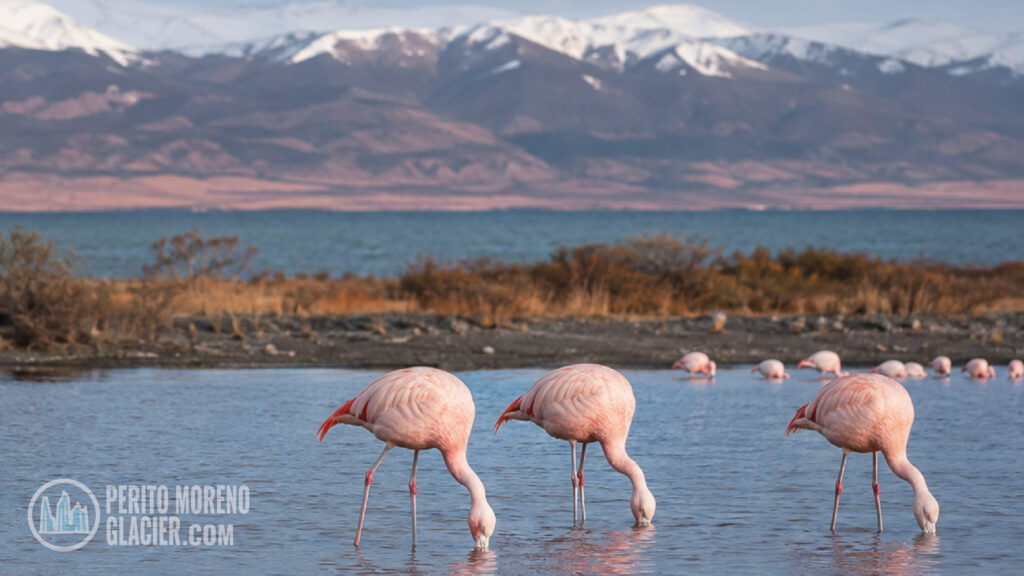
- Flamingos reflected in calm shallow water
- A feeding group with synchronized curved necks
- Pink birds contrasted against blue-grey Lago Argentino
- Flamingos framed by reeds or grassland
- A wide scene including the Andes
- Adults and greyer juveniles together
- Wing-stretching behavior revealing darker flight feathers
Binoculars and Other Useful Equipment
Bring binoculars if you own them. An 8×42 model is an excellent general choice because it balances magnification, field of view and brightness. A 10×42 model provides more reach but may be harder to hold steady in strong wind.
Also carry:
- Windproof and waterproof outer layer
- Warm mid-layer
- Hat and gloves outside the warmest days
- Closed shoes with reliable grip
- Sunglasses and sunscreen
- Water in a reusable bottle
- Camera rain cover or dry bag
- Lens cloth
- Fully charged battery and spare memory card
- Small notebook or bird-list app
The reserve has visitor information and may offer bird guides and binocular-related services, but availability should be confirmed directly rather than assumed.
5-day W Trekking with EcoCamp in Torres del Paine
The famous W Trekking in Torres del Paine, in a 5-day program with base in EcoCamp!
Flamingo Behavior to Watch
Filter Feeding
Look for birds sweeping an inverted bill through the water. Foot shuffling may help stir organisms from the lagoon bottom. Feeding birds can remain in one area for a long time if conditions are productive.
Resting on One Leg
Flamingos often rest on one leg, with the other tucked against the body. This position is normal and helps reduce heat loss; it is not usually a sign of injury.
Preening
Birds use their bills to arrange and maintain feathers. Preening may reveal stronger color on the wings and produces interesting curved-neck shapes for photography.
Social Movement
Flamingos are highly social. Watch how a few individuals change direction and influence the rest of a group. Small interactions, spacing and vocal communication often tell more of the story than a static portrait.
Flight
In flight, the extended neck and legs create a long, unmistakable profile. Black and deeper pink wing areas become much more visible. Observe naturally occurring departures without clapping, shouting or moving toward the birds.
Other Birds You May See
Although this guide concentrates on flamingos, visitors should also look for black-necked swans, coscoroba swans, upland geese, crested ducks, red shovelers, yellow-billed pintails, coots, grebes, black-faced ibises, southern lapwings and Magellanic oystercatchers.
Grassland and shrubland may reveal austral negritos, long-tailed meadowlarks, rufous-collared sparrows and other small birds. Raptors can pass overhead. Species and abundance depend on season and habitat conditions.
Check more informationabout Birds of El Calafate & Perito Moreno Glacier
Responsible Flamingo Watching
- Stay on authorized paths, boardwalks, viewpoints and hides.
- Keep voices low and movements slow.
- Never enter the water or vegetation for a photograph.
- Do not feed birds or leave food scraps.
- Avoid flash photography.
- Never use drones unless explicit current regulations permit them; wildlife disturbance and local restrictions make them inappropriate in many protected areas.
- Do not play recorded calls to attract birds.
- Keep children close and explain why chasing birds is harmful.
- Carry out all litter, including tissues and small plastic items easily blown away.
- Follow reserve staff instructions even if a bird appears closer elsewhere.
An ethical image records natural behavior. If a bird stops feeding, repeatedly watches you, walks away or takes flight because of your approach, you are too close.
Complete Ushuaia in two days: Tierra del Fuego NP + Train + Beagle Channel Navigation + Fagnano and Escondido Lakes
Enjoy a combination of four amazing activities in two single days in Ushuaia
Can You Visit Laguna Nimez with Children?
Yes. The easy trail, visible large birds and interpretation signs can make Laguna Nimez one of El Calafate’s most engaging nature experiences for families. Keep expectations realistic: children may enjoy a shorter section more than a slow three-hour birding circuit.
Bring wind protection, water and sun protection. Ensure children remain on the path, do not run toward wildlife and use hides quietly. Minors under 18 are currently listed as free on the official rates page, but confirm the policy before visiting.
Is Laguna Nimez Suitable for Seniors?
Many active seniors can comfortably enjoy the reserve because the trail is largely easy and does not involve mountain elevation. Wind, cold, walking distance and uneven sections may be more relevant than gradient.
Ask staff about the day’s trail condition, nearby observation points and places to rest. A shorter visit using the most accessible viewpoints can still provide meaningful birdwatching.
Can You Visit on Your Arrival or Departure Day?
Laguna Nimez is one of the best flexible activities for a partial day in El Calafate. Its proximity to town makes it suitable after morning arrival or before an evening departure, provided you allow enough time for airport transfer and respect reserve hours.
Do not schedule it too tightly after a delayed flight. A relaxed 90-minute visit is better than rushing around the full circuit while repeatedly checking the time.

El Calafate Full Pass
A full package service to El Calafate and Perito Moreno! This full pass will save you money and organize your trip.
How to Combine Laguna Nimez with Other El Calafate Experiences
With Downtown El Calafate
Walk from the center, visit the reserve for two hours and return for lunch, shopping or dinner. This is the simplest combination and requires no full-day excursion.
With the Glaciarium
The wetland and the glacier interpretation center offer complementary perspectives: living ecosystems in town and regional ice science outside it. Check transport and opening times before pairing them.
With Perito Moreno Glacier
Perito Moreno is generally a full-day experience. Laguna Nimez can work on the preceding evening or the following morning, but it should not reduce the time allocated to the national park.
For glacier planning, link to What to Do at the Perito Moreno Glacier.
With a Free Afternoon
The reserve is ideal after a boat excursion only when the vessel returns early enough and the traveler still has energy. Confirm closing time rather than assuming long summer daylight means the entrance remains open.
Laguna Nimez vs. Seeing Flamingos from the Public Lakeshore
Birds can sometimes be observed from public sections of the Lago Argentino shoreline. However, the reserve provides a managed interpretive circuit, different wetland habitats, designated viewpoints, hides and conservation support.
The two experiences are not interchangeable. A free lakeshore sighting may be enjoyable, while admission to Laguna Nimez contributes to organized habitat protection, visitor management and environmental education. The reserve also gives a better framework for understanding what you are seeing.
Australis Expedition Cruise from Ushuaia to Punta Arenas – 1 Night Free
Embark on a 4-Night Cruise to Discover the Unique Landscapes of Remote Patagonia - Plus, Enjoy a Free Night's Stay!
Frequently Asked Questions
Are There Really Flamingos in El Calafate?
Yes. Wild Chilean flamingos use Laguna Nimez and other suitable wetlands in the region. Their presence and position vary naturally.
Is Laguna Nimez Inside Los Glaciares National Park?
No. It is a municipal nature reserve within El Calafate, beside Lago Argentino. A visit does not replace Los Glaciares National Park or the Perito Moreno Glacier.
How Long Should I Spend at Laguna Nimez?
Allow around 1½ to 3 hours. Birdwatchers and photographers may want longer, while travelers with limited time can enjoy a shorter section.
Do I Need a Guide?
No. The circuit is designed for self-guided visits and includes interpretation. A specialist guide can add value for serious bird identification or photography.
Do I Need to Book in Advance?
Independent visits generally do not require a complex reservation, but group policies and operational conditions may differ. Contact the reserve directly for school groups, large parties or special requirements.
Are Binoculars Essential?
They are not mandatory, but they greatly improve the experience because flamingos and other birds may remain far from the trail.
Can I See Flamingos in Winter?
It is possible, but no season guarantees a particular flock. Check recent local observations and dress for cold, wind and limited daylight.
Is the Trail Wheelchair Accessible?
Accessibility can depend on the exact sector, surface and recent weather. Contact the reserve for current, route-specific information rather than assuming the full 3-kilometer circuit is uniformly accessible.
Can I Use a Drone?
Do not bring or launch one without explicit current authorization. Drones can disturb birds and are commonly restricted in protected natural settings.
Is Laguna Nimez Worth Visiting If I Am Not a Birdwatcher?
Yes. The reserve offers an easy walk, open views, Lago Argentino scenery and an introduction to the wetland ecosystem. It is especially valuable as a quiet contrast to glacier excursions.

El Calafate Standard Pass
This pass will save you money and organize your trip. A basic package of services for visiting El Calafate and Perito Moreno in 2, 3, or 4 days!
Suggested Internal Links
- Birds of El Calafate & Perito Moreno Glacier
- The Patagonian Steppe
- Weather in El Calafate and Perito Moreno Glacier Area
- What to Do at the Perito Moreno Glacier
- Nightlife in El Calafate: What Can I Do After a Day of Touring?
Final Tips for Seeing Flamingos at Laguna Nimez
Treat Laguna Nimez as a living wetland rather than a flamingo exhibit. Arrive with enough time, ask about current sightings, complete as much of the interpretive loop as conditions allow and pay attention to every habitat—not only the first pink birds you notice.
Bring binoculars, prepare for wind and use a long lens if photography matters. Most importantly, let the flamingos determine the distance. The finest Laguna Nimez experience is one in which visitors leave with photographs and understanding while the birds continue feeding exactly as they did before anyone arrived.
Big Ice & Estancia Cristina Adventure – 3 Nights
Enjoy visiting Perito Moreno Glacier, walking over the ice of the glacier and a wonderful trekking or horseback riding in a remote estancia in the national park

Perito Moreno Ice Trekking & Spirit of the Glaciers – 4 Nights
4 nights in the glaciers area to enjoy Perito Moreno Glacier and the incredible Spirit of the Glacier Cruise in a 2-day boat navigation